Adolescence has always been a time of testing limits, trying new things, and figuring out who you are. But when substances enter the picture, a parent’s mind can jump straight to the worst-case scenario. The truth is that trying a substance doesn’t automatically mean a child has a substance use disorder, and what’s really going on can be harder to see than it seems.
In this episode of You Only Know What You Know, hosts Beth Hope, LCSW, and Britt Teasdale talk with Kaitlin Thompson, LCSW, CADC, Director, Compass Health Center’s Center of Excellence, about how substance use and mental health intersect, which warning signs parents should watch for, and how to start these conversations without making a child feel like they’re in trouble.
Download the Parent Resource Guide Here
Meet the Guest
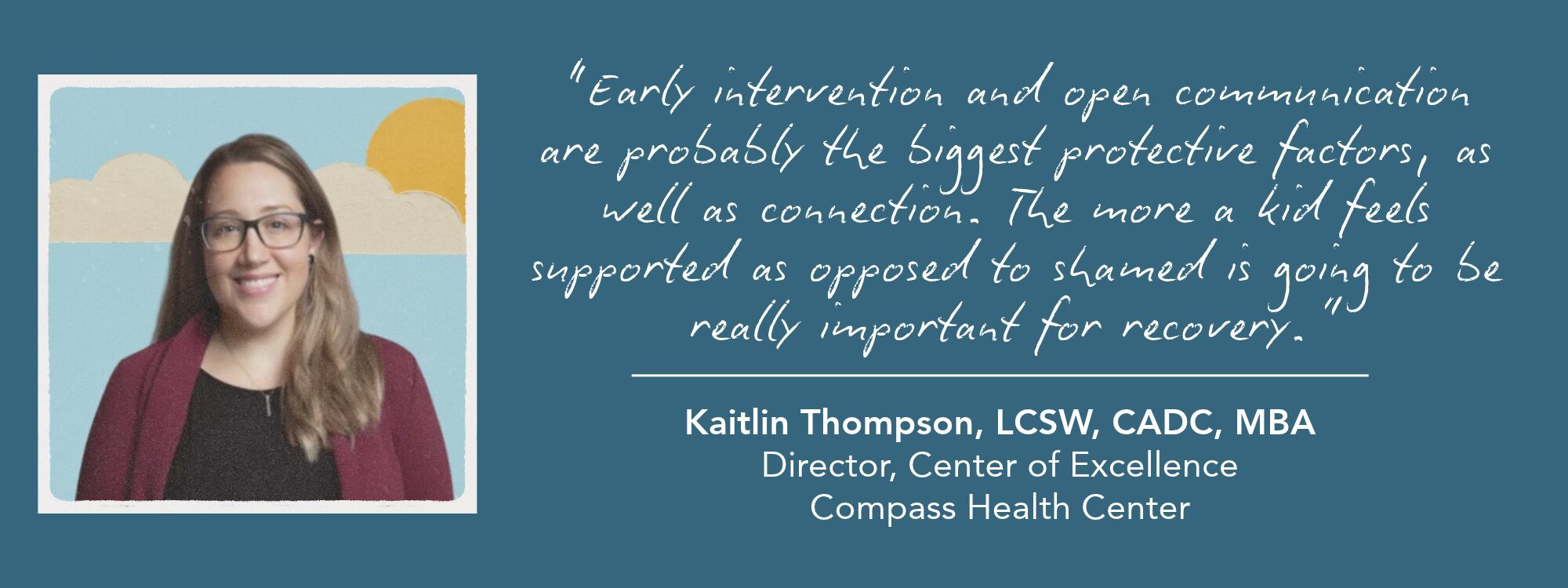
Kaitlin Thompson, LCSW, CADC
Kaitlin Thompson is a licensed clinical social worker and certified alcohol and other drug abuse counselor, and a director at Compass Health Center’s Center of Excellence. She has worked in mental health and substance use for nearly 20 years, across group homes, inpatient detox, and outpatient care, and now in Compass’s Partial Hospitalization (PHP) and Intensive Outpatient (IOP) programs. She also holds an MBA in healthcare management.
Episode Highlights
The conversation below comes from episode 14 of You Only Know What You Know featuring Kaitlin Thompson, LCSW, CADC. The transcript has been lightly edited for length and readability.
What does “substance use” actually mean?
Kaitlin Thompson, LCSW, CADC: Substance use is the broadest term. It simply means someone is consuming any substance at any level, and it exists on a spectrum. At one end is overall use, which could be recreational use or experimentation. Then we start to think about problematic or unhelpful use, and evaluate whether it meets criteria for a substance use disorder, or addiction, which is the phrase most people use for the extreme end of the spectrum.
When does experimenting with substances become a concern?
Kaitlin Thompson, LCSW, CADC: One of the main things is what function the substance use is serving. We often think of peer pressure, but it can be more nuanced: not wanting to be the odd man out, fear of rejection, wanting to feel less awkward, soothing social anxiety, or coping with other mental health symptoms.
Parents know their kids best. Risk factors include a co-occurring mental health concern, a history of trauma, a family history of substance use, using in isolation, and use that’s escalating quickly or involves secrecy. Signs to watch for include a significant change in mood, isolation, a change in school or sports performance, withdrawing from friends, a change in anxiety or depression symptoms, or use that’s getting more frequent or intense. Those are signs the “experimentation” may be evolving into something more concerning.
How can I talk to my teen without scare tactics?
Kaitlin Thompson, LCSW, CADC: What definitely doesn’t work is scare tactics. The “this is your brain on drugs” approach doesn’t help kids understand real consequences, and it can almost make substances forbidden fruit. Instead, be open and honest about the real risks, including why teens are more vulnerable than adults.
You can validate your child’s emotions or reasons for using while still setting firm boundaries and consequences. And you can say, “If you’re ever in an unsafe situation, call me and I’ll pick you up, no questions asked.” That doesn’t mean I’m okay with you doing whatever you want. It means I’m prioritizing your safety.
You also don’t have to know everything about every substance. Let your child know you might not have all the answers, but you can figure it out together. And if you’re angry or afraid in the moment, give yourself time to regulate before you talk, so the conversation doesn’t push your child further away or make them feel like they just need to hide it better.
Why do some teens use substances to cope, and what does “co-occurring” mean?
Kaitlin Thompson, LCSW, CADC: The function can evolve. What starts as social connection or curiosity can turn into avoiding withdrawal or coping with anxiety and depression, especially as the brain and body adapt to regular use. That can sneak up on kids.
Co-occurring means someone is struggling with both substances and a mental health issue, like anxiety, depression, trauma, OCD, or ADHD. It’s much more common than substance use occurring in a vacuum. Even if substances help manage symptoms in the moment, they can make them worse once the effects wear off. Symptoms increase, use increases, and it’s a tough cycle to break. That’s why the recommendation, at Compass and in the field in general, is to treat both at the same time.
Do family history or ADHD raise the risk?
Kaitlin Thompson, LCSW, CADC: The teenage brain is already at higher risk. The reward system develops early, while the prefrontal cortex, which helps with long-term thinking and impulse control, doesn’t fully develop until the mid-twenties. ADHD can add differences in dopamine regulation, which can mean more risk-seeking and difficulty managing impulses.
For family history, studies are mixed, but some estimate the risk may be two to four times higher. It’s not destiny, though. Being honest with kids about what puts them at higher risk helps them make better-informed choices, and the earlier you start, in age-appropriate language, the better.
What levels of care are available, and will getting help follow my child?
Kaitlin Thompson, LCSW, CADC: We think about what level of care fits based on severity. The first step might be an outpatient therapist or the school guidance counselor. If that isn’t enough, the next level is a program like Compass’s IOP or PHP, where teens attend treatment multiple days a week. If there are serious safety concerns and they can’t keep themselves safe, we might look at residential or inpatient care. Ideally, the sooner you intervene, the better, and we want to keep kids at the lowest level of care that works.
If you’re worried about stigma, research what the real consequences are. There are confidentiality laws around treatment, and schools may be punitive about use on campus, but not about seeking treatment. Then ask what matters more: reputation, or health and safety.
What are the signs of an emergency?
Kaitlin Thompson, LCSW, CADC: When in doubt, call 911. Warning signs include being unconscious, shallow breathing, blue lips, disorientation, not being able to answer simple questions, or stumbling. It’s better to err on the side of caution. If your child was a little intoxicated, the worst case is they’re evaluated and found to be medically stable, and that’s confidential. If there’s a real risk of overdose, every minute counts.
If you have any suspicion of opioid use, keeping Narcan on hand is a good move. It’s cheap, available over the counter, and can rapidly reverse an opioid overdose.
What should I do if I just found out my child is using substances?
Kaitlin Thompson, LCSW, CADC: Try not to panic. Lots of teens use substances and are okay. Take a breath, slow down, open the conversation, and try to understand the why. And take care of yourself, because parenting in this world is very hard.
It also helps to look at the family as a whole. Kids who are struggling are often labeled “the problem,” but the whole family often needs support to create an environment where the child can recover. That’s not to say it’s the parents’ fault. Early intervention and open communication are probably the biggest protective factors, along with connection. The more a kid feels supported instead of shamed, the better their recovery.
Take the First Step with Compass Health Center
If you’re worried about your child’s substance use or mental health, you don’t have to figure it out alone. Call 877-552-6672 or schedule a conversation with an intake specialist to talk about whether Compass’s Mental Health & Substance Use Treatment program is the right fit.
If you think your child is having an emergency, call 911. If you or someone you love is in crisis, call or text 988 (Suicide & Crisis Lifeline), available 24 hours a day.