As a parent, you naturally want your children to be happy and healthy. We understand the impact that depression and anxiety can have on a teenager’s life. This program is designed with the well-being of your teen in mind, specifically tailored to address how depression and/or anxiety may be affecting their daily functioning at home and in school.

Ages 13-18
Immediate, Specialized Mental Health Treatment for Teens
As a parent, witnessing your teenager navigate mental health challenges can be heart-wrenching. At Compass Health Center, we recognize the depth of your concern and the urgency for evidence-based, compassionate solutions. Our specialized teen mental health treatment programs are tailored to meet the unique needs of adolescents, providing a path to healing and resilience.
Adolescent Mental Health Treatment Goals
Our primary mission is to offer immediate answers and access to adolescent mental health treatment in a nurturing, non-hospital setting. Compass Health Center’s environment is designed to be a safe haven where your teen can freely express their emotions, develop essential coping mechanisms, and foster resilience. Through a personalized treatment plan that encompasses therapy sessions, evidence-based strategies, and unwavering support, our dedicated team of professionals is committed to empowering your teen to navigate life’s hurdles with confidence.
Many teens and their families worry about the potential disruptions that seeking a higher level of mental health treatment may entail. We understand these concerns and strive to ensure that our program supports your teen in:
Resuming participation in school, social activities, and age-appropriate events:
We believe in the importance of maintaining a balanced life, and our program is designed to integrate with your teen’s daily routine.
Boosting self-esteem and confidence:
A strong sense of self is essential for adolescent development, and our treatment goals include improving your teen’s self-esteem and confidence.
Developing effective strategies for emotional regulation:
Learning to manage and regulate emotions is a critical skill for adolescents, and our treatment plans are focused on teaching these vital strategies.
Enhancing communication and interpersonal skills:
Strong relationships are built on effective communication, and our program focuses on strengthening these skills to improve interactions with family and peers.
Recognizing their strengths, talents, and potential:
Every teen has unique gifts, and our program helps them to see and develop these.
Reducing the likelihood of needing higher levels of mental health care:
By addressing concerns early and providing comprehensive care, we aim to decrease the need for more intensive mental health services in the future.
Age-Specific PHP and IOP Programs
Explore Our Teen Mental Health Services
For many families new to youth mental health services, terms like Partial Hospitalization (PHP) and Intensive Outpatient (IOP) programs can seem daunting. However, these programs play a crucial role in bridging the gap in adolescent mental health care. Compass Health Center offers both PHP and IOP options to accommodate different needs and schedules. PHP provides a structured, daytime program for those requiring more intensive support, while IOP offers flexibility with evening sessions. Both settings offer comprehensive care for a range of emotional and psychological challenges, acting as vital alternatives to traditional outpatient therapy, emergency room visits, or more restrictive forms of care.

AGES 13-18
Mood & Anxiety Treatment
Learn MoreIn our depression and anxiety program, you can expect a compassionate and supportive environment where your teen’s well-being is our top priority. Your teen will undergo a thorough evaluation so we can better understand their unique challenges, strengths, and treatment needs. Based on the assessment results, we will develop a personalized treatment plan tailored to their specific mental health symptoms, goals, and preferences. They’ll work directly towards these goals with clinicians who specialize in adolescent mental health care using a variety of evidence-based therapies.
Understandably, mental health and substance use can impact a teenager's ability to thrive in school. Our academic support services help high school students manage their academic responsibilities while addressing their treatment needs. Compass Health Center educators work with your teen to develop effective study skills, time management strategies, and organizational methods to improve their academic performance.
IOP
PHP




Virtual PHP and IOP for Teens
Compass Health Center’s Virtual Adolescent PHP and IOP programs deliver comprehensive, evidence-based clinical care—paired with a curriculum teens actually engage in. Interactive groups, movement and art blocks, executive-function coaching, and individual and family therapy.
- Structure & Support: Daily group therapy with integrated psychiatry, individual, and family sessions.
- Teen-Ready Design: 45–60 minute blocks with movement, art, mindfulness, and executive-function skills.
- School Alignment: PHP includes close coordination between Compass education specialists and teachers; after-school IOP options make treatment fit within school life.
- Evidence-Based: Proven outcomes that match in-person care, with the flexibility families need.
Families can choose daytime PHP, after-school IOP, or evening programs (for 18+).Available in Illinois, Maryland, Minnesota, Wisconsin, Virginia, and Washington, D.C.

Addressing the Distinct Mental Health Needs of Teens
Adolescence is a unique and formative period of life. During this developmental stage, teens are faced with significant physical and hormonal changes, all while figuring out who they are and how to navigate increasingly complex social dynamics. These transitions can contribute to heightened levels of stress, anxiety, and mood fluctuations—making teenagers vulnerable to mental health challenges.

The Importance of Behavioral Therapy for Teens
Behavioral therapy offers a structured and evidence-based approach to help teens understand their thoughts, emotions, and behaviors so they can develop coping mechanisms to navigate life’s challenges successfully. By teaching practical skills like problem-solving, emotion regulation, and communication, behavioral therapy enables teenagers to cope with stress, manage conflicts, and build healthy relationships.
Our Treatment Approach and Methodologies
Our youth mental health services are personalized, evidence-based, and delivered by trained clinicians who specialize in working with teenagers. We use a diverse range of evidence-based therapies to ensure that every teen receives effective care, tailoring treatment to their specific preferences and strengths. Our approach allows your teen to explore different avenues for healing, growth, and self-discovery.
ERP is one of the most effective treatments for Obsessive Compulsive Disorder (OCD) and other complex anxiety diagnoses, including Illness Anxiety Disorder, Panic Disorder, Social Anxiety Disorder, and other anxiety disorders. Patients gradually confront their feared object or situation in a hierarchical, prolonged, and planned manner. By doing so, patients learn to gain mastery over their anxiety and fears.
CPT addresses “stuck points” (trauma-centered cognitive distortions) via applying cognitive-behavioral techniques, such as Socratic dialogue, challenging questions, and collaborative identification of common thinking errors. These interventions aid patients’ trauma recovery processes, allowing for more flexible thinking and the development of new, balanced beliefs.
Motivational Interviewing is a therapeutic technique that helps individuals bridge the gap between their current behavioral choices and their identified goals. The four tenets of Motivational Interviewing (MI) are facilitating engagement, focusing on goals, evoking awareness and motivation, and planning for reasonable steps to move toward helpful goals. Open-ended questions, validation, reflective listening, and summarizing are helpful tools to guide these steps.
Emotion regulation refers to adjusting or modulating one’s emotions. The phrase “Emotion Regulation” is a DBT term that denotes a set of skills designed to help individuals both increase resilience to intense emotions and decrease suffering related to emotions. These skills are not designed to “eliminate” or “avoid” emotions, but rather to help individuals identify and express emotions, alter their responses to their emotions, shift the emotions they are experiencing and/or the intensity of their emotions, and navigate difficult to sit with emotions safely and effectively.
Interpersonal effectiveness refers to constructive communication. The phrase “Interpersonal Effectiveness” is a DBT term that denotes a set of skills designed to help individuals manage challenging situations, validate the emotions and experience of self and others, improve and maintain current connections, and create new meaningful relationships. Interpersonal Effectiveness skills offer concrete guidance and support around balancing acceptance and change within relationships, asserting wants and needs in effective ways that maintain the relationship, and navigating complex situations in values-aligned ways.
ACT is an evidence-based therapeutic model that combines behavior modification interventions with specific types of acceptance and mindfulness exercises. ACT aims to change a person’s relationship with their own troubling thoughts, whether it is ruminating on past mistakes, focusing on potential threats in the future, or feeling overwhelmed by traumatic memories. In changing how a person thinks about and responds to these troubling thoughts, that person frees themselves up to live a value-based, rich, full, and meaningful life. Since there is no manualized protocol for ACT, Compass adapts tools to meet patients and groups where they are at in their treatment journey. These tools assist patients in making room for their emotional experiences and to have space to focus on identifying and doing what is most important to them.
DBT is an evidence-based model of treatment designed by Dr. Marsha Linehan to help patients build meaningful lives and improve their ability to regulate emotions. DBT guides patients through identifying patterns in thinking, behavior, emotions, and interpersonal interactions that contribute to problems in living. Once identified, the goal is to change these patterns using coping skills. The “D” in DBT refers to dialectics, the presence or co-occurrence of two seemingly contradictory or opposing concepts simultaneously. DBT centers on the dialectic of acceptance and change and encourages individuals to walk the middle path between the two, working to balance acceptance (“I’m doing the best I can,” “this is how things are right now”) and change (“I need to try different for things to be different”). DBT comprises four central tenets to help people accept and change: Mindfulness, Distress Tolerance, Interpersonal Effectiveness, and Emotion Regulation.
Mindfulness is a term used in various ways based on setting and context. DBT defines Mindfulness as “the act of consciously focusing the mind in the present moment without judgment and attachment to the moment.” Mindfulness is active—it is something all people can engage in, actively choose to do, and can develop into practice with repeated effort. Most Mindfulness activities and tools, including the DBT Mindfulness skills, are adapted from cultural and spiritual traditions like meditation and breathwork. DBT Mindfulness skills help individuals practice being fully present in the moment, tuning in to what is happening inside and around them, and moving forward aligned with inner wisdom.
Distress tolerance refers to sitting with experiences of distress (distressing thoughts, emotions, urges, and/or physiological responses). In DBT, distress tolerance refers to specific skills designed to help individuals navigate crisis moments as effectively as possible. These skills focus on guiding individuals through radically accepting the situation as it is and, at the same time, working to change what they can. DBT Distress Tolerance skills support individuals in skillfully moving through distressing realities without increasing their suffering.
Art therapy is a specific type of experiential therapy that engages individuals in art-making and creative expression to explore internal experiences, build insight, and learn and apply skills related to treatment goals. Art therapy is a therapeutic intervention led by professionally trained art therapists with specific educational and practical experiences. At Compass, art therapy is integrated into programming in age-specific, values-aligned, and skills-focused ways.
Executive functioning skills are mental skills that allow a person to organize, plan, and follow instructions, think flexibly, and demonstrate impulse control. These skills are utilized daily as individuals prioritize tasks, achieve goals, and learn. Executive function challenges can make it hard to focus, follow directions, and regulate emotions. Executive function skills are learned; patients benefit from modeling and explicit teaching.
Additional Resources
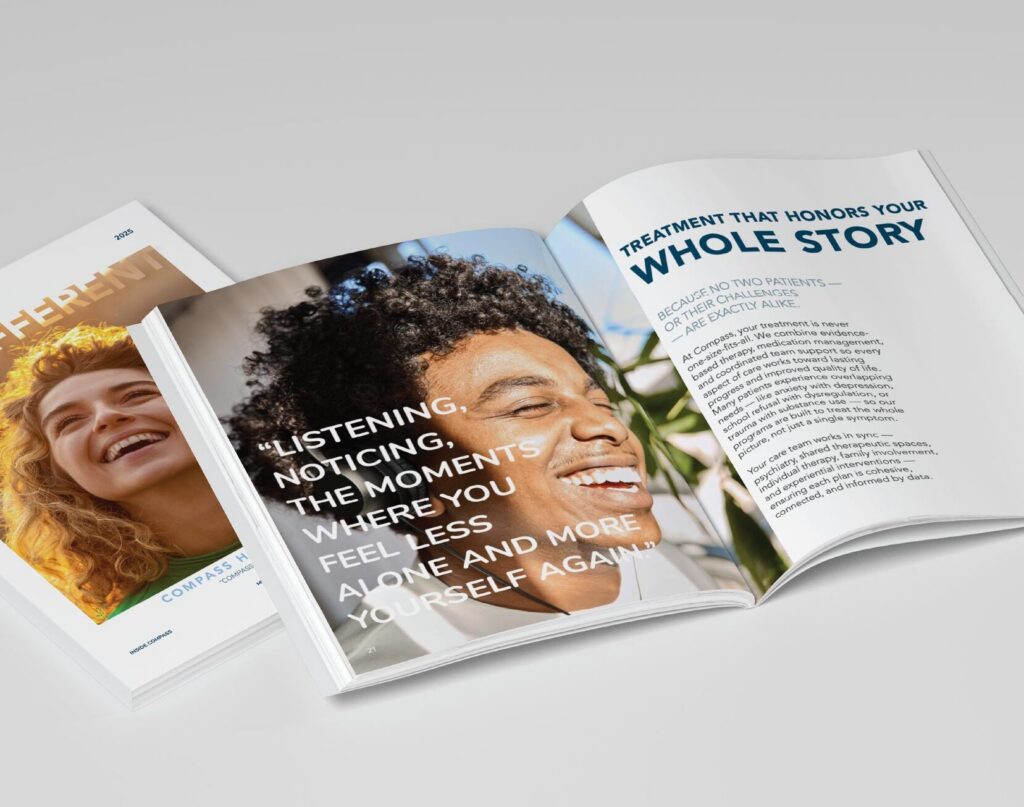
Forward: The Compass Lookbook
When you can see how care actually works—and what it feels like—it’s easier to take the first step. Forward offers a clear look at our approach and philosophies, so nothing feels unfamiliar before you begin.

Insurance & Billing Support
Navigating the financial aspects of treatment can feel overwhelming. That’s why we’re here to provide help every step of the way, ensuring that your focus remains where it matters most: supporting your teen through their mental health journey. A dedicated Patient Advocate will be by your side, offering personalized guidance tailored to your unique situation. Whether you have questions about coverage, claims, or billing processes, our compassionate team is here to provide clarity and support.

Parents & Family Guide
Our comprehensive guide is a trusted resource for parents and family members supporting their teen’s mental health journey, offering valuable insights, practical advice, and compassionate guidance. Whether you have questions about treatment approaches, communication strategies, or self-care practices, our accessible resources support you in navigating your teen’s treatment with confidence and compassion, knowing that you’re not alone.
Our Impact
We understand that success can look different for everyone depending on your hopes and needs. Here are a few ways we define success:
95%
of patients step down to a lower level of care after treatment
99%
would refer a family member or friend
97%
of patients choose to start a program the same day or next day
90%
of patients maintain progress, not requiring higher care levels for 12+ months post-treatment

Compass has it "down" in helping their patients! A very complete and comprehensive program. We were impressed with the services and the compassion our son received.

Having never gone through something like this…the process was simple and you never felt like you did something wrong (as a parent). You felt like part of the team trying to do what is best for your child.

I felt very safe and listened to in this program. I felt like I could be my authentic self and I wouldn't be judged for it.

I have learned so much and used so many skills in such a small amount of time,
and I think that's astounding.

Thank you all for everything! For the past month and a half Compass has been a safe space for me.
Service Areas