Compass Health Center accepts most major commercial insurance plans. Insurance benefits and coverage are verified individually, call us to understand how Compass works with you to make care as affordable as possible.
Young Child and Child Mental Health Treatment
Guiding Little Steps through Big Feelings
Parenting a child with big emotions can feel overwhelming—and at times, exhausting. You’re here seeking support, and that means you’re already doing something brave. Compass Health Center’s Young Child and Child treatment programs provide family-centered care for children ages 5–14. Our team is here to help you and your child build skills and strategies to help increase the calm, connection, and confidence in your home, at school, and in the community.
About the Program
Program offerings may differ by location. Kindly call us to confirm specific program details.
Ages
- Young Child (5-12)
- Child (8-13)
Treatment Levels
- IOP
- PHP
In-Person
- Northbrook, IL
- Oak Brook, IL
- Chicago, IL
Program Overview
Supporting families as children learn to regulate, relate, and reconnect
When a child’s emotions become overwhelming—showing up as tantrums, defiance, anxiety, or withdrawal—it can affect every part of family life. Knowing when it’s the right time to seek more support can be difficult—and finding the right support can feel just as hard. Our goal is to offer a space that supports both your child and your family as you navigate the challenges that can come with childhood mental and behavioral health concerns. Compass Health Center’s Young Child and Child treatment programs in Chicago, Northbrook, and Oak Brook, Illinois, provide short-term, comprehensive care for children ages 5–14 who struggle to manage emotions or behaviors that disrupt their routines at home and school.
Our multidisciplinary treatment teams help children:
Understand and express emotions in healthy ways
Build coping and problem-solving skills
Strengthen frustration tolerance and flexibility
Improve communication and social relationships
Reconnect with curiosity, confidence, and joy in learning
Parents and caregivers are active partners in treatment, gaining tools to support emotional growth and consistency at home.

Programs
Runs Monday through Friday, with program hours aligned to the typical school day.
A full-day, structured level of care for children whose emotional or behavioral difficulties are interfering with daily life. The PHP provides stability and coordinated, multidisciplinary support, helping children return to school and extracurricular routines with stronger coping skills, self-regulation, and renewed confidence.
For children stepping down from PHP or needing more support than weekly therapy, the IOP offers after-school treatment focused on emotion regulation, anxiety management, and family collaboration—all while maintaining their daytime school schedules.
At our Chicago location, both PHP and After-School IOP are available for children ages 5–10. Designed for emotional and behavioral dysregulation, the program helps children build skills in emotion identification, distress tolerance, emotional regulation, relaxation strategies, and effective communication—supporting greater stability at home, in school, and in daily routines. Young child programming generally begins at age 5, though offerings vary by location based on your child’s needs and clinical recommendations. Please call to learn more.
Not Sure If This Program Is Right for You?
You’re not alone. Many people come to us feeling uncertain, unsure if what they’re going through is “serious enough” or if they’re ready for treatment.
Here’s the truth: If you’re feeling stuck, overwhelmed, or like things are getting worse—not better— we’re here to help.
Let’s take the first step together.
Who We Help
Every feeling is a chance to grow
Children who would benefit from this program may experience:
- Frequent or intense emotional outbursts
- Difficulty calming down after becoming upset
- Aggression, irritability, or oppositional behavior
- Persistent anxiety or panic
- Sadness, withdrawal, or low mood
- School avoidance or refusal
- Challenges following directions or maintaining friendships
If your child’s emotions often feel “too big”—or if anxiety or school challenges are beginning to impact daily life—Compass can help you understand what’s really happening and what can help.
Families seeking support for mood or anxiety concerns may consider our Child Mood & Anxiety Program, and those experiencing school avoidance or school-related anxiety can learn more about our Child School Anxiety & Refusal Program.
How Treatment Works
Specialized, evidence-based care for emotional and behavioral dysregulation in children
Each child’s treatment plan is uniquely designed by Compass’s team of child psychiatrists, therapists, and experiential specialists, and include:
- Immediate psychiatric assessment and medication management (typically within 24–48 hours of starting a program)
- Individual and group therapy focused on emotion regulation, distress tolerance, and social skill-building
- Family therapy and parent support groups to strengthen communication and structure
- Evidence-based therapy modalities, including Cognitive Behavioral Therapy (CBT), Dialectical Behavior Therapy (DBT), and Mindfulness
- Experiential therapies such as creative expression, recreation, mindfulness, movement, and animal-assisted therapy
- Academic coordination to maintain learning progress, align support across settings, and reduce school-related stress
- Specialized programs and services for OCD, mood and anxiety disorders, school anxiety and refusal, and emotional/behavioral dysregulation vary by site and age.
Children and families gain tools to manage symptoms, regulate emotions, and return to school or social settings with greater confidence and stability.
Support for Parents
Where parents and children grow stronger, side by side
Parent involvement is essential to a child’s long-term progress. You play one of the most powerful roles in a child’s growth and healing. We only know what we know in this moment—and that’s okay— as parents, we are all still learning. As you gain a deeper understanding of how to interpret and respond to your child’s behaviors, the whole family begins to feel more connected, confident, and capable.
Our program provides ongoing education and support so parents can better understand what drives their child’s emotions and how to respond in ways that promote calm and connection.
Each family’s involvement may include:
- Family therapy to strengthen communication and mutual understanding
- Parent strategy groups to learn effective tools for managing emotions and behaviors at home
- Monthly skill reviews to reinforce progress and keep growth going beyond treatment at Compass
When parents learn new ways to respond to big emotions, children learn new ways to express them—and the whole family begins to feel better.
Academic and School Coordination
Nurturing emotional growth and a love of learning
In PHP, your child will receive daily educational support during the school year to stay on track academically while focusing on emotional well-being. Our team collaborates with each child’s teachers and school counselors to ensure a smooth return to the classroom and to address issues such as school avoidance, test anxiety, or peer stress that may contribute to dysregulation.
Learn more about our specialized Child School Anxiety & Refusal Program.
Why Compass
Helping children find balance in a world that feels big
Compass Health Center’s expert clinicians provide compassionate, evidence-based care for children experiencing emotional and behavioral dysregulation, anxiety, or mood challenges. Our integrated, experiential model allows children to learn in the ways that feel most natural to them—through creativity, movement, and connection.
Families leave with:
- A shared language for emotions
- Tools to navigate anxiety and mood shifts
- Practical skills that promote stability and confidence
For children whose anxiety, mood symptoms, OCD, or school stress require more targeted treatment, explore:
Because learning to regulate emotions is a skill for life
When a child struggles with intense emotions, the whole family feels it. If your child is having a hard time managing emotions, anxiety, or behavioral challenges, Compass Health Center can help. Our compassionate team is here to guide your family toward stability, understanding, and renewed connection.
For More Information or to Schedule an Assessment, Call Us or Fill Out the Form Below.
Frequently Asked Questions
Often times, this can present as verbal and/or physical aggression that takes place in the home, at school, etc. Every child is different. For some, you might see only verbal vs physical aggression. For others, behaviors might only be displayed in the home.
Often times, children have difficulty regulating and managing their emotions. This is developmentally appropriate as it is a skill they are learning. Emotional dysregulation can be impacted by biology/genetics, environment and age.
The young child program works with children ages 5-10 years old. The child program works with children ages 10-14.
Yes, our contact center conducts an initial screening to determine if an intake assessment is appropriate. If so, a family will then complete a 1-1.5 hour intake assessment where clinical information is obtained and a recommendation for treatment is made.
It depends. It certainly can change/improve as a child ages and often intervention with therapeutic and/or psychiatric treatment can support improvement in symptoms of dysregulation.
Yes. Depending on your program, there are parent support groups. Additionally, family therapy/support is a part of treatment. This can look like family session (onsite or virtual), parent only sessions, parent coaching via phone, etc. The level of intervention will be determined by your treatment team.
At Compass Health Center, we want to make sure that your child can get the healthcare they need, regardless of your insurance coverage. We accept most commercial insurance plans, and we offer flexible payment plans to help make our services more affordable. Our billing team works with the patient/family to establish any plans needed.
Our Impact
We understand that success can look different for everyone depending on your hopes and needs. Here are a few ways we define success:
95%
of patients step down to a lower level of care after treatment
99%
would refer a family member or friend
97%
of patients choose to start a program the same day or next day
90%
of patients maintain progress, not requiring higher care levels for 12+ months post-treatment
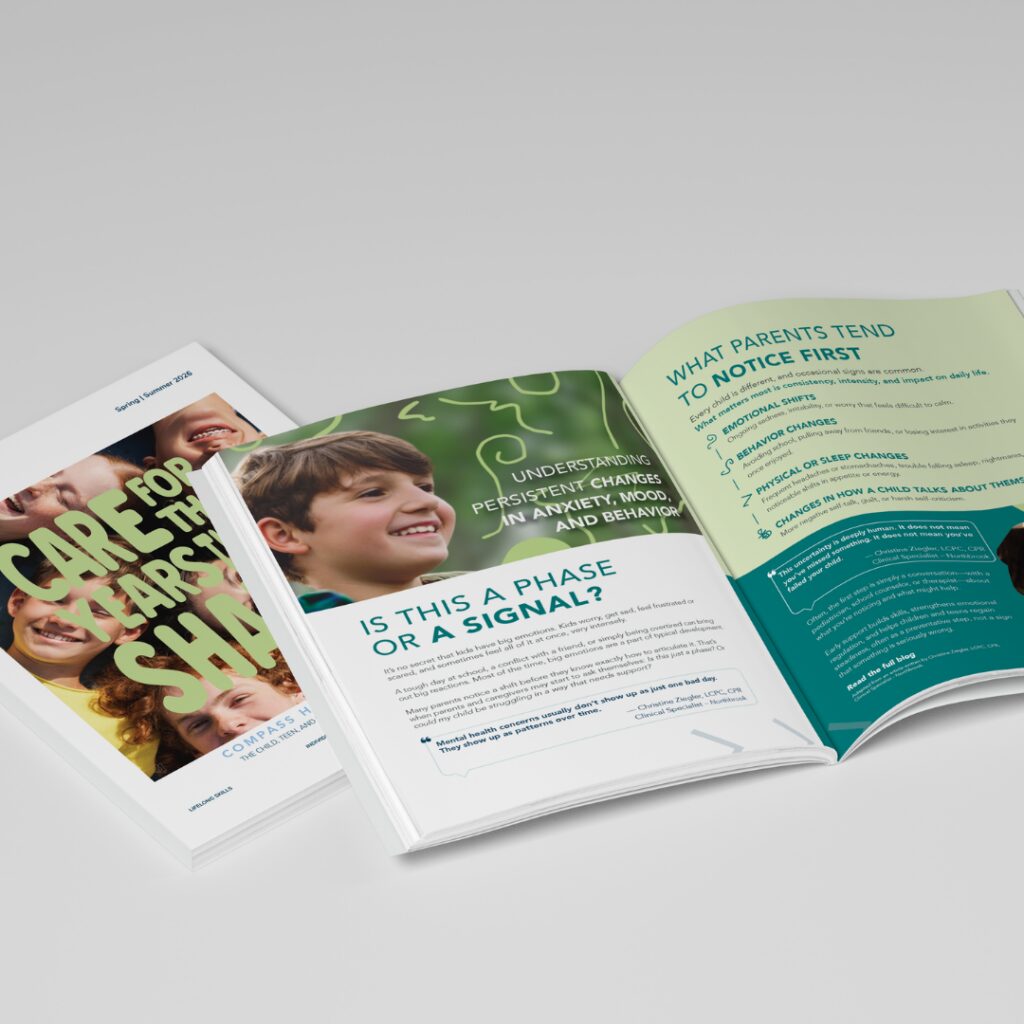
Meet Forward, Compass Health Center’s Lookbook
Mental health care is changing—and so is the way we tell its story.
Forward is a collection of voices, insights, and design that feels less like a brochure and more like a magazine you’d actually want to flip through. We created this Lookbook to show how care can be approachable, engaging, and thoughtfully designed—just as our treatment experience is. Inside, you’ll find our philosophy, programs, and patient outcomes shaping Compass care today, and what’s next.