


Compass Health Center accepts most major commercial insurance plans. Insurance benefits and coverage are verified individually, call us to understand how Compass works with you to make care as affordable as possible.

Program FinderSchedule an Appointment

After-School IOP

After the bell rings, we’re here

School matters. So does your child’s mental health. Our After-School Intensive Outpatient Program (IOP) is designed for the hours after the bell rings—when there’s space to focus on what your child needs to build confidence and resilience, without losing the rhythm of their day.

About the Program

Program offerings may differ by location. Kindly call us to confirm specific program details.

Ages

  • Child (8-13)
  • Teen (13-18)

Treatment Levels

  • IOP

In-Person

  • Chicago, IL
  • Northbrook, IL
  • Oak Brook, IL
  • Silver Spring, MD

Virtual Locations

  • Illinois
  • Maryland
  • Minnesota
  • Wisconsin
  • Virginia

Program Overview

Support after school, stability throughout the day

For many families, finding care that supports a child’s mental health without interrupting school can feel impossible. Our After-School Intensive Outpatient Program (IOP) was created to make treatment more accessible—providing comprehensive, evidence-based care in the late afternoon and evening.

Designed for children and teens experiencing anxiety, depression, OCD, emotional dysregulation, or other mental health challenges, this program allows students to:

  • Attend school during the day
  • Receive comprehensive, structured therapy and psychiatric care after classes
  • Continue developing coping skills while maintaining daily routines

Mental health care shouldn’t mean falling behind. Our after-school programs help families find balance when more support is needed.

Ages

Care shaped by who they are and who they’re becoming

Our Child After-School IOP combines psychiatry, medication management, creative therapies, skill-building groups, executive functioning support, and family sessions to help children identify emotions, manage stress, and improve communication, all while maintaining their regular school routine. Parents participate through education and coaching, learning strategies that extend progress at home.

*On a case-by-base basis, Compass accepts children as young as five into the after school IOP program. Program offerings may differ by location. Kindly call us to confirm specific program details.


Our Adolescent After-School IOP provides the same comprehensive treatment as our Child Program, delivered through age-appropriate support for anxiety, depression, mood instability, stress management, and other symptoms. Teens receive specialized care that strengthens emotional insight, accountability, executive functioning, and self-confidence—while staying connected to academics, sports, and friends.

Who We Help

For students who need more support—without missing school

Our After-School IOP supports children and teens who may be:

  • Struggling with anxiety, mood, or emotional regulation
  • Experiencing increased stress or avoidance around school or peers
  • Having difficulty transitioning home after school
  • Needing more structure and support than weekly outpatient therapy or psychiatry provides
  • Stepping down from Partial Hospitalization (PHP)

What to Expect

A steady after-school structure

Every participant receives a personalized care plan developed by our multidisciplinary team, which includes:

Mental health assessments within 24 hours, with program entry as soon as the next day.

Concurrent treatment for co-occurring mental health and substance use disorders.

On-call prescribers available around the clock for urgent needs outside program hours.

Tailored care plans built around each participant’s goals for sustainable progress.

A psychiatrist or psychiatric nurse practitioner follows each participant throughout treatment and manages medication when appropriate.

Gold-standard clinical approaches rooted in research and best practices.

Individual therapy is a confidential, one-on-one session between a patient and a licensed therapist focused on supporting mental health treatment through evidence-based care. In these sessions, the therapist and patient work together to explore thoughts, emotions, and behaviors, identify unhelpful patterns, and develop personalized coping strategies and treatment goals. 

Group therapy includes one or two group facilitators and a cohort of participants (typically between 4 – 16 people in the space). The number and make-up of participants in each group may depend upon program census, type/content of group, and various other factors. The group therapy space is developed to be a confidential and supportive milieu in which participants can learn and practice coping skills and discuss topics to build insight and actively move towards identified treatment goals. Group members are encouraged to validate and relate to each other and engage with therapists to discuss and process skill integration, emotions, and thought processes that influence specific behaviors and share about current struggles and successes. Group therapy at Compass Health Center focuses on building awareness around behavioral goals, learning and practicing evidenced-based skills, and using a confidential space to process relevant and relatable topics with peers. Group facilitators guide understanding related to skills and topics linked to ACT, DBT, and CBT while connecting these topics to treatment objectives and skill application and integration in the home, school, and work settings. Groups may be didactic, psychoeducational, interpersonal/process, or experiential and often employ multiple techniques to increase engagement and impact.
Family therapy occurs between a therapist and all or some family members. It is often focused on exploring the dynamics within a family, improving communication, resolving conflict, and helping families live more harmoniously. Supporting families in family therapy to integrate evidence-based skills as a family and as individuals can be incredibly impactful. Skills can help family members feel more connected with one another and empower them to manage stressors in the family system. At times, the therapist might want to meet with individuals alone to prepare for sessions with the whole family system; however, most of the treatment is provided with families together. At Compass, family therapy is an essential part of our treatment model. Ensuring our patients and their loved ones feel informed, supported, and engaged in the treatment process and practicing evidence-based skills is a top priority. Our dedicated family therapists work closely with patients to identify who should participate in family therapy sessions and to create a focus for those sessions to best support their goals at Compass.
Art therapy is a specific type of experiential therapy that engages individuals in art-making and creative expression to explore internal experiences, build insight, and learn and apply skills related to treatment goals. Art therapy is a therapeutic intervention led by professionally trained art therapists with specific educational and practical experiences. At Compass, art therapy is integrated into programming in age-specific, values-aligned, and skills-focused ways.
ACT is an evidence-based therapeutic model that combines behavior modification interventions with specific types of acceptance and mindfulness exercises. ACT aims to change a person’s relationship with their own troubling thoughts, whether it is ruminating on past mistakes, focusing on potential threats in the future, or feeling overwhelmed by traumatic memories. In changing how a person thinks about and responds to these troubling thoughts, that person frees themselves up to live a value-based, rich, full, and meaningful life. Since there is no manualized protocol for ACT, Compass adapts tools to meet patients and groups where they are at in their treatment journey. These tools assist patients in making room for their emotional experiences and to have space to focus on identifying and doing what is most important to them.
CBT is an evidence-based, present-focused, structured, and time-sensitive therapy proven effective by thousands of studies over decades for many physical and mental health concerns. CBT centers around the interconnectedness of a person’s thoughts, emotions, behaviors, and physiological responses. CBT posits that the way one perceives and reacts to a situation causes them the most distress, rather than the situation itself. CBT offers skills to reduce distress by helping individuals identify distorted thinking patterns, evaluate their effectiveness, and reframe thinking to more realistic and helpful thoughts. CBT focuses on building awareness of what an individual experiences in the here and now and then problem-solve using this insight to create change in thinking patterns and behaviors using this increased insight and specific coping skills.
DBT is an evidence-based model of treatment designed by Dr. Marsha Linehan to help patients build meaningful lives and improve their ability to regulate emotions. DBT guides patients through identifying patterns in thinking, behavior, emotions, and interpersonal interactions that contribute to problems in living. Once identified, the goal is to change these patterns using coping skills. The “D” in DBT refers to dialectics, the presence or co-occurrence of two seemingly contradictory or opposing concepts simultaneously. DBT centers on the dialectic of acceptance and change and encourages individuals to walk the middle path between the two, working to balance acceptance (“I’m doing the best I can,” “this is how things are right now”) and change (“I need to try different for things to be different”). DBT comprises four central tenets to help people accept and change: Mindfulness, Distress Tolerance, Interpersonal Effectiveness, and Emotion Regulation.

Flexibility That Works for Families

Care that protects the school day

Sessions typically run Monday through Friday, after school hours, allowing students to maintain their daytime routines while receiving high-quality care in the evenings.

  • Continue attending school during the day
  • Maintain friendships and continue engaging in extracurriculars
  • Get home at a reasonable hour with clear strategies to manage emotions and stress

Our goal is simple: provide the depth of treatment your child needs without disrupting the rhythm of their life.

Parent Involvement

Care that works with your day, not against it

We know progress doesn’t happen without understanding and family support. Parents and caregivers are active participants in every step of care, learning practical tools to create structure, reduce conflict, and reinforce emotional regulation at home.

Family components include:

  • Weekly family therapy
  • Parent skills groups
  • Education on communication, consistency, and self-care

When families grow in understanding, children gain confidence—and everyone starts to feel better.

Why Compass

Care that holds the day together

Compass Health Center’s After-School IOP provides a middle level of support between weekly outpatient therapy and full-day PHP treatment. Our programs are psychiatrist-led, team-based, and grounded in evidence-based care, yet designed to fit into real family life.

Families leave with:

  • Improved coping and communication skills
  • Greater stability at home and school
  • A renewed sense of hope, connection, and progress

Start with a conversation

If your child or teen is struggling to manage anxiety, mood, or stress but needs to stay in school and can manage their classes, Compass Health Center’s After-School IOP can help. Our flexible, family-centered approach allows real growth to happen, alongside busy school days.

For More Information or to Schedule an Assessment, Call Us or Fill Out the Form Below.

Our Impact

We understand that success can look different for everyone depending on your hopes and needs. Here are a few ways we define success:

95%
of patients step down to a lower level of care after treatment

99%
would refer a family member or friend

97%
of patients choose to start a program the same day or next day

90%
of patients maintain progress, not requiring higher care levels for 12+ months post-treatment

Compass saved my life! I came into Compass with suicidal ideations and no hope. After a couple of weeks of being in the program, I did not have those thoughts anymore. Compass helped me change my mindset, from a negative pattern of thoughts to a more positive and optimistic frame of mind.

Adult Patient

My child is leaving Compass more equipped to handle her emotions, her anxiety, her depression, and the things that all trigger these. She is willing to use the skills, which is a huge change, and this is all due to how well Compass worked for her.

Parent of Child Patient

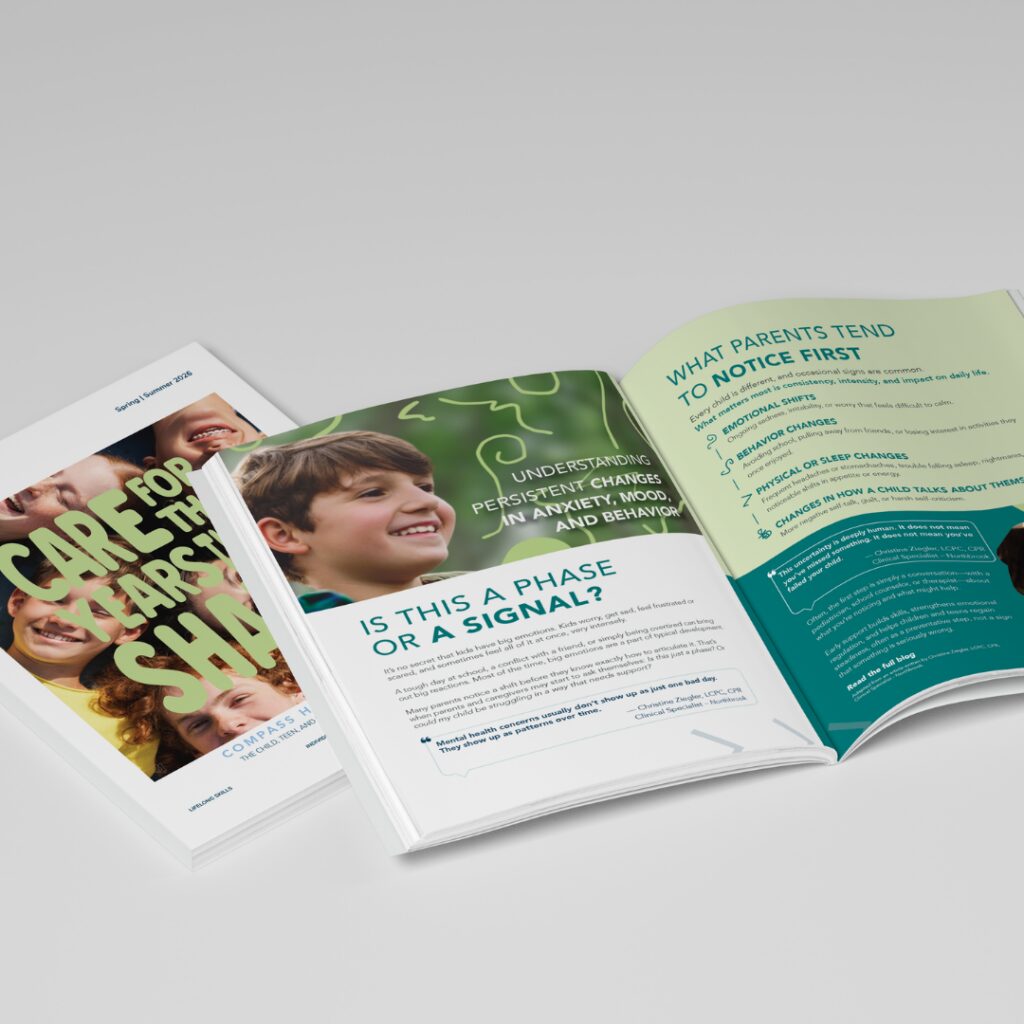
Meet Forward, Compass Health Center’s Lookbook

Mental health care is changing—and so is the way we tell its story.

Forward is a collection of voices, insights, and design that feels less like a brochure and more like a magazine you’d actually want to flip through. We created this Lookbook to show how care can be approachable, engaging, and thoughtfully designed—just as our treatment experience is. Inside, you’ll find our philosophy, programs, and patient outcomes shaping Compass care today, and what’s next.