Younger children often experience school anxiety through physical symptoms (stomachaches, tears, panic) or emotional outbursts. They may fear separation or feel overwhelmed by new expectations. Our Child School Anxiety & Refusal program blends structured therapy with play, movement, and creative expression to help children understand emotions, build flexibility, and regain confidence in daily routines. Parents receive ongoing coaching and support to make mornings and transitions smoother.

School Anxiety & Refusal Treatment
Because mornings shouldn’t feel this hard
Some mornings, it starts with tears, stomachaches, or panic. Other days, it’s a complete shutdown. The backpack stays by the door, the clock ticks forward, and you both end up feeling defeated. Sometimes, it’s a call from school: they couldn’t make it through the day. You’ve tried everything: reassurance, routines, and patience. Still, school feels impossible. It’s not defiance. It’s distress. And it’s heartbreaking to watch.
We understand how consuming school avoidance can become—for the child or teen who’s scared, the parent who’s worried, and the family trying to keep life on track. Our School Anxiety & Refusal treatment programs help children and teens rebuild confidence, manage anxiety, and re-engage with school and daily life at a pace that feels safe and supported.
About the Program
Program offerings may differ by location. Kindly call us to confirm specific program details.
Ages
- Young Child (5-12)
- Child (8-13)
- Teen (13-18)
Treatment Levels
- IOP
- PHP
In-Person
- Chicago, IL
- Northbrook, IL
- Oak Brook, IL
- Silver Spring, MD
- Brookfield, WI
- Golden Valley, MN
Virtual Locations
- Illinois
- Maryland
- Minnesota
- Washington, DC
- Wisconsin

Understanding School Anxiety & Refusal
Helping students return to school—and themselves—with confidence
When anxiety takes over, school can start to feel unsafe—not because of what’s happening there, but because of how overwhelming it feels inside. For some children, that can show up as tears, physical complaints, or panic. For teens, it might look like withdrawal, avoidance, or falling grades.
Parents often describe feeling helpless, frustrated, or uncertain about what to do next. We get it—because you’re not just trying to get your child to school, you’re trying to protect them from emotional pain.
Our programs help families understand what’s underneath school avoidance, whether it’s separation anxiety, social fears, academic pressure, or broader mood challenges—and build tools for confidence and calm.
The goal isn’t just getting back to school. It’s helping your child feel safe, capable, and ready to learn again.

Program Overview
Turn “I can’t” into “I can”
When you stop asking “why won’t they just go?” and start asking “what’s keeping them from it?”—everything shifts. Our School Anxiety & Refusal programs provide short-term, structured treatment through Partial Hospitalization (PHP) and Intensive Outpatient (IOP) levels of care.
We combine psychiatry, therapy, school collaboration, and family support to help children and teens return to school with less fear and more resilience. We guide families toward mornings that feel manageable again.
Our multidisciplinary team helps participants:
Identify and manage anxiety and mood symptoms
Build coping tools for school-related stress
Reconnect with peers and teachers
Rebuild structure and confidence
Strengthen problem-solving and communication
Not Sure If This Program Is Right for You?
You’re not alone. Many people come to us feeling uncertain, unsure if what they’re going through is “serious enough” or if they’re ready for treatment.
Here’s the truth: If you’re feeling stuck, overwhelmed, or like things are getting worse—not better— we’re here to help.
Let’s take the first step together.

Ages
Because behind every “I can’t” is a student who wants to try
School anxiety and refusal look different at every age. Our programs are tailored to meet children and teens where they are, developmentally and emotionally.
Adolescents may withdraw, procrastinate, or feel paralyzed by perfectionism, social pressures, or burnout. Our Teen School Anxiety & Refusal program focuses on emotional regulation, motivation, and academic re-engagement. Therapy addresses the anxiety, self-doubt, and depression that often accompany school avoidance, while helping teens rebuild trust in themselves and their future.

What to Expect
Specialized, evidence-based care built around every student’s needs
Every treatment plan is individualized and may include:
- Comprehensive psychiatric evaluation and medication management
- Individual therapy with a dedicated primary therapist
- Group therapy focused on anxiety, coping skills, and connection
- Family therapy and parent strategy sessions
- Experiential therapies such as art, recreation, mindfulness, and yoga
- School collaboration to ensure smooth academic reintegration
- Collaborative nursing support
Our clinicians specialize in school anxiety, avoidance, and mood disorders, using Cognitive Behavioral Therapy (CBT), Dialectical Behavior Therapy (DBT), Exposure and Response Prevention (ERP), and Acceptance and Commitment Therapy (ACT) to promote lasting change.

Program Options
It takes a village—and a plan. Every morning is a new chance to try again
Partial Hospitalization Program (PHP)
A structured, full-day treatment option for children and teens whose school anxiety or avoidance is significantly disrupting daily life. PHP provides stability, therapeutic care, and school coordination to help students rebuild confidence and readiness to return.
Intensive Outpatient Program (IOP)
An after-school or step-down program designed for students reintegrating into school or managing lingering anxiety. IOP focuses on reinforcing coping skills, maintaining routines, and sustaining progress at home and in class.

Academic Support
Helping students move from survival mode to learning mode
Education is an integral part of each patient’s treatment plan. During PHP, students receive daily academic support from Compass’s education specialists, who collaborate directly with schools to maintain progress and prepare for re-entry.
We work with school teams to:
- Support academic planning during treatment
- Address attendance concerns and reintegration goals
- Communicate progress and accommodations
We don’t just help your child return to school—we help them feel ready to learn again. Every return to school is its own kind of bravery.

Support for Parents
You’re not failing—you’re managing more than most people see
When school avoidance becomes part of daily life, mornings can feel like emotional minefields. You might worry about your child’s future, question your parenting, or feel torn between empathy and exhaustion.
We’re here to help you, too.
Parent participation includes:
- Family therapy to strengthen connection and understanding
- Parent strategy groups to build consistency and confidence at home
- Ongoing collaboration with your child’s school and care team
When parents learn new strategies to respond with both structure and compassion, mornings—and family dynamics—begin to change. When parents feel supported, children feel safer.

Support for Parents
You’re not failing—you’re managing more than most people see
When school avoidance becomes part of daily life, mornings can feel like emotional minefields. You might worry about your child’s future, question your parenting, or feel torn between empathy and exhaustion.
We’re here to help you, too.
Parent participation includes:
- Family therapy to strengthen connection and understanding
- Parent strategy groups to build consistency and confidence at home
- Ongoing collaboration with your child’s school and care team
When parents learn new strategies to respond with both structure and compassion, mornings—and family dynamics—begin to change. When parents feel supported, children feel safer.

Move toward calmer mornings and closer connections
If your child or teen is struggling with school anxiety or avoidance, Compass Health Center can help. You don’t have to face it alone. There is a way forward.
Specialized, evidence-based care built around every student’s needs
Every treatment plan is individualized and may include:
One-on-one sessions with Master’s- and doctoral-level clinicians specializing in eating disorder treatment.
Clinical nutrition guidance aligned with a Health At Every Size-informed, weight-inclusive approach.
Secure telehealth care that meets individuals and families where they are, regardless of location in the state.
Individual therapy is a confidential, one-on-one session between a patient and a licensed therapist focused on supporting mental health treatment through evidence-based care. In these sessions, the therapist and patient work together to explore thoughts, emotions, and behaviors, identify unhelpful patterns, and develop personalized coping strategies and treatment goals.
Family therapy occurs between a therapist and all or some family members. It is often focused on exploring the dynamics within a family, improving communication, resolving conflict, and helping families live more harmoniously. Supporting families in family therapy to integrate evidence-based skills as a family and as individuals can be incredibly impactful. Skills can help family members feel more connected with one another and empower them to manage stressors in the family system. At times, the therapist might want to meet with individuals alone to prepare for sessions with the whole family system; however, most of the treatment is provided with families together. At Compass, family therapy is an essential part of our treatment model. Ensuring our patients and their loved ones feel informed, supported, and engaged in the treatment process and practicing evidence-based skills is a top priority. Our dedicated family therapists work closely with patients to identify who should participate in family therapy sessions and to create a focus for those sessions to best support their goals at Compass.
Group therapy includes one or two group facilitators and a cohort of participants (typically between 4 – 16 people in the space). The number and make-up of participants in each group may depend upon program census, type/content of group, and various other factors. The group therapy space is developed to be a confidential and supportive milieu in which participants can learn and practice coping skills and discuss topics to build insight and actively move towards identified treatment goals. Group members are encouraged to validate and relate to each other and engage with therapists to discuss and process skill integration, emotions, and thought processes that influence specific behaviors and share about current struggles and successes. Group therapy at Compass Health Center focuses on building awareness around behavioral goals, learning and practicing evidenced-based skills, and using a confidential space to process relevant and relatable topics with peers. Group facilitators guide understanding related to skills and topics linked to ACT, DBT, and CBT while connecting these topics to treatment objectives and skill application and integration in the home, school, and work settings. Groups may be didactic, psychoeducational, interpersonal/process, or experiential and often employ multiple techniques to increase engagement and impact.
ERP is one of the most effective treatments for Obsessive Compulsive Disorder (OCD) and other complex anxiety diagnoses, including Illness Anxiety Disorder, Panic Disorder, Social Anxiety Disorder, and other anxiety disorders. Patients gradually confront their feared object or situation in a hierarchical, prolonged, and planned manner. By doing so, patients learn to gain mastery over their anxiety and fears.
DBT is an evidence-based model of treatment designed by Dr. Marsha Linehan to help patients build meaningful lives and improve their ability to regulate emotions. DBT guides patients through identifying patterns in thinking, behavior, emotions, and interpersonal interactions that contribute to problems in living. Once identified, the goal is to change these patterns using coping skills. The “D” in DBT refers to dialectics, the presence or co-occurrence of two seemingly contradictory or opposing concepts simultaneously. DBT centers on the dialectic of acceptance and change and encourages individuals to walk the middle path between the two, working to balance acceptance (“I’m doing the best I can,” “this is how things are right now”) and change (“I need to try different for things to be different”). DBT comprises four central tenets to help people accept and change: Mindfulness, Distress Tolerance, Interpersonal Effectiveness, and Emotion Regulation.
CBT is an evidence-based, present-focused, structured, and time-sensitive therapy proven effective by thousands of studies over decades for many physical and mental health concerns. CBT centers around the interconnectedness of a person’s thoughts, emotions, behaviors, and physiological responses. CBT posits that the way one perceives and reacts to a situation causes them the most distress, rather than the situation itself. CBT offers skills to reduce distress by helping individuals identify distorted thinking patterns, evaluate their effectiveness, and reframe thinking to more realistic and helpful thoughts. CBT focuses on building awareness of what an individual experiences in the here and now and then problem-solve using this insight to create change in thinking patterns and behaviors using this increased insight and specific coping skills.
ACT is an evidence-based therapeutic model that combines behavior modification interventions with specific types of acceptance and mindfulness exercises. ACT aims to change a person’s relationship with their own troubling thoughts, whether it is ruminating on past mistakes, focusing on potential threats in the future, or feeling overwhelmed by traumatic memories. In changing how a person thinks about and responds to these troubling thoughts, that person frees themselves up to live a value-based, rich, full, and meaningful life. Since there is no manualized protocol for ACT, Compass adapts tools to meet patients and groups where they are at in their treatment journey. These tools assist patients in making room for their emotional experiences and to have space to focus on identifying and doing what is most important to them.
CPT addresses “stuck points” (trauma-centered cognitive distortions) via applying cognitive-behavioral techniques, such as Socratic dialogue, challenging questions, and collaborative identification of common thinking errors. These interventions aid patients’ trauma recovery processes, allowing for more flexible thinking and the development of new, balanced beliefs.
Executive functioning skills are mental skills that allow a person to organize, plan, and follow instructions, think flexibly, and demonstrate impulse control. These skills are utilized daily as individuals prioritize tasks, achieve goals, and learn. Executive function challenges can make it hard to focus, follow directions, and regulate emotions. Executive function skills are learned; patients benefit from modeling and explicit teaching.
Interpersonal effectiveness refers to constructive communication. The phrase “Interpersonal Effectiveness” is a DBT term that denotes a set of skills designed to help individuals manage challenging situations, validate the emotions and experience of self and others, improve and maintain current connections, and create new meaningful relationships. Interpersonal Effectiveness skills offer concrete guidance and support around balancing acceptance and change within relationships, asserting wants and needs in effective ways that maintain the relationship, and navigating complex situations in values-aligned ways.
Distress tolerance refers to sitting with experiences of distress (distressing thoughts, emotions, urges, and/or physiological responses). In DBT, distress tolerance refers to specific skills designed to help individuals navigate crisis moments as effectively as possible. These skills focus on guiding individuals through radically accepting the situation as it is and, at the same time, working to change what they can. DBT Distress Tolerance skills support individuals in skillfully moving through distressing realities without increasing their suffering.
Emotion regulation refers to adjusting or modulating one’s emotions. The phrase “Emotion Regulation” is a DBT term that denotes a set of skills designed to help individuals both increase resilience to intense emotions and decrease suffering related to emotions. These skills are not designed to “eliminate” or “avoid” emotions, but rather to help individuals identify and express emotions, alter their responses to their emotions, shift the emotions they are experiencing and/or the intensity of their emotions, and navigate difficult to sit with emotions safely and effectively.
Mindfulness is a term used in various ways based on setting and context. DBT defines Mindfulness as “the act of consciously focusing the mind in the present moment without judgment and attachment to the moment.” Mindfulness is active—it is something all people can engage in, actively choose to do, and can develop into practice with repeated effort. Most Mindfulness activities and tools, including the DBT Mindfulness skills, are adapted from cultural and spiritual traditions like meditation and breathwork. DBT Mindfulness skills help individuals practice being fully present in the moment, tuning in to what is happening inside and around them, and moving forward aligned with inner wisdom.
Recreation therapy at Compass Health Center is an evidence-based treatment modality that uses structured recreational and experiential activities to support mental health recovery and skill development. Led by trained recreation therapists, these sessions focus on improving emotional regulation, social skills, stress management, and overall well-being through activities such as movement, games, creative expression, and mindfulness-based exercises. Recreational therapy availability varies by program and location.
Art therapy is a specific type of experiential therapy that engages individuals in art-making and creative expression to explore internal experiences, build insight, and learn and apply skills related to treatment goals. Art therapy is a therapeutic intervention led by professionally trained art therapists with specific educational and practical experiences. At Compass, art therapy is integrated into programming in age-specific, values-aligned, and skills-focused ways.
Art therapy is a therapeutic modality that utilizes art materials and the artistic process alongside work with an art therapist within a therapeutic setting. Art materials aid clients in communicating and processing their emotions through non-verbal means. By observing the process, form, content, interests, and comments, an art therapist comprehensively assesses a client’s needs and determines treatment plans to restore, maintain or improve an individual’s mental health.
Motivational Interviewing is a therapeutic technique that helps individuals bridge the gap between their current behavioral choices and their identified goals. The four tenets of Motivational Interviewing (MI) are facilitating engagement, focusing on goals, evoking awareness and motivation, and planning for reasonable steps to move toward helpful goals. Open-ended questions, validation, reflective listening, and summarizing are helpful tools to guide these steps.
Animal-assisted therapy at Compass Health Center is a structured, goal-directed therapeutic intervention that incorporates interactions with trained therapy animals as part of a patient’s overall treatment plan. Guided by a licensed clinician, these sessions use animal interactions to help patients reduce anxiety, build emotional regulation skills, increase motivation, and improve social engagement. Animal therapy availability varies by program and location.
Parents often carry a quiet weight: uncertainty, self-doubt, and the sense that they should know how to fix what is happening. Parent groups provide space to learn skills, ask questions, and hear from others navigating similar challenges. These conversations often bring relief as much as information.
For More Information or to Schedule an Assessment, Call Us or Fill Out the Form Below.
Frequently Asked Questions
School Refusal
School refusal isn’t defiance—it’s distress. Children and teens who struggle with school avoidance are typically experiencing real anxiety, whether tied to separation fears, social pressure, academic stress, or broader mood challenges. Compass Health Center’s School Anxiety & Refusal program is built around identifying what’s underneath the avoidance and treating those root causes, rather than simply pushing a child back through the door.
Compass Health Center’s School Anxiety & Refusal program uses a combination of Cognitive Behavioral Therapy (CBT), Dialectical Behavior Therapy (DBT), Exposure and Response Prevention (ERP), and Acceptance and Commitment Therapy (ACT). Treatment is delivered through individual therapy, group therapy, family sessions, and psychiatric care. All treatment is tailored to a child’s age, symptoms, and the specific factors driving their school avoidance.
Yes, school collaboration is a built-in part of the program. During PHP, students receive daily academic support from Compass’s education specialists, who coordinate directly with school teams on attendance concerns, academic planning, and reintegration goals. The aim is to make the return to school feel supported on both ends—not just clinically prepared, but practically ready.
Compass Health Center offers both Partial Hospitalization (PHP) and Intensive Outpatient (IOP) levels of care for school anxiety and refusal. PHP is a structured, full-day program suited for children and teens whose avoidance is significantly disrupting daily life. IOP is an after-school or step-down option for students who are reintegrating into school and need continued support reinforcing coping skills and routines.
Yes; in fact, co-occurring anxiety and depression are among the most common drivers of school refusal, and Compass Health Center’s clinicians specialize in treating both. Whether your child seems withdrawn, perfectionistic, socially avoidant, or is experiencing physical symptoms like stomachaches and panic, the individualized treatment plan addresses the full picture of what’s keeping them from school—not just the attendance problem itself.
Our Impact
We understand that success can look different for everyone depending on your hopes and needs. Here are a few ways we define success:
95%
of patients step down to a lower level of care after treatment
99%
would refer a family member or friend
97%
of patients choose to start a program the same day or next day
90%
of patients maintain progress, not requiring higher care levels for 12+ months post-treatment

My child is leaving Compass more equipped to handle her emotions, her anxiety, her depression, and the things that all trigger these. She is willing to use the skills, which is a huge change, and this is all due to how well Compass worked for her.

I have learned so much and used so many skills in such a small amount of time,
and I think that's astounding.

I know it’s a lot to handle, but throughout my time here I made friends and I’ve grown a lot as a person. The best advice I can give is to not fight the process.

Compass has it "down" in helping their patients! A very complete and comprehensive program. We were impressed with the services and the compassion our son received.
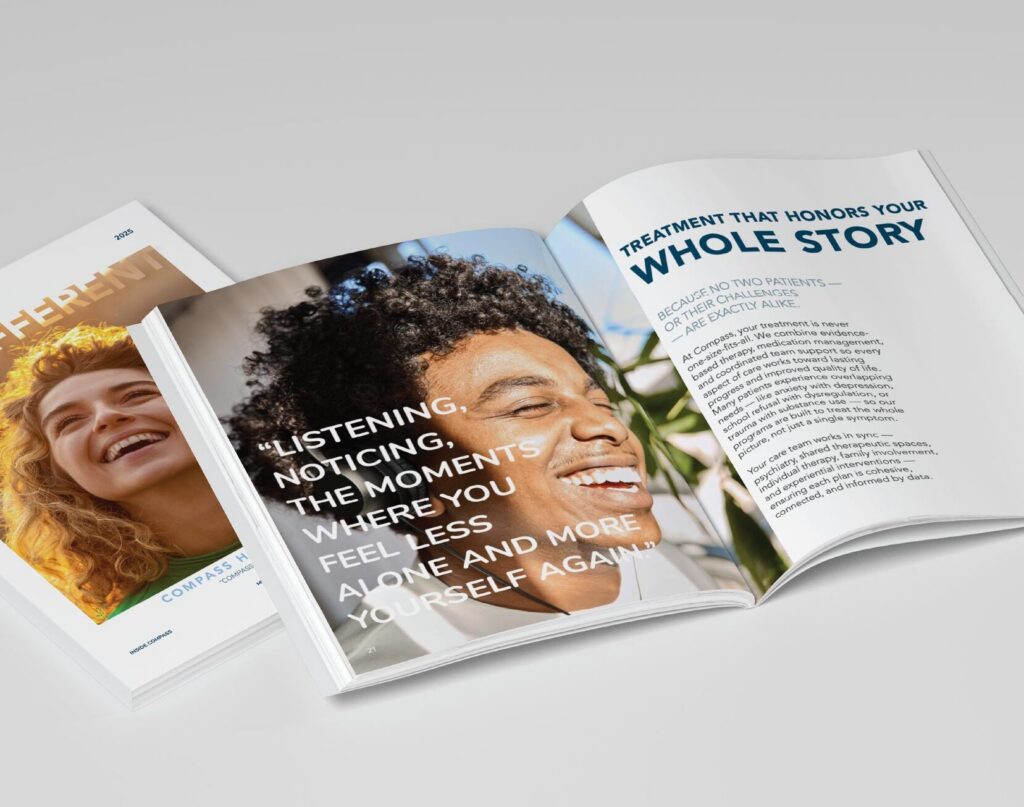
Meet Forward , Compass Health Center’s Lookbook
Mental health care is changing—and so is the way we tell its story.
Forward is a collection of voices, insights, and design that feels less like a brochure and more like a magazine you’d actually want to flip through. We created this Lookbook to show how care can be approachable, engaging, and thoughtfully designed—just as our treatment experience is. Inside, you’ll find our philosophy, programs, and patient outcomes shaping Compass care today, and what’s next.
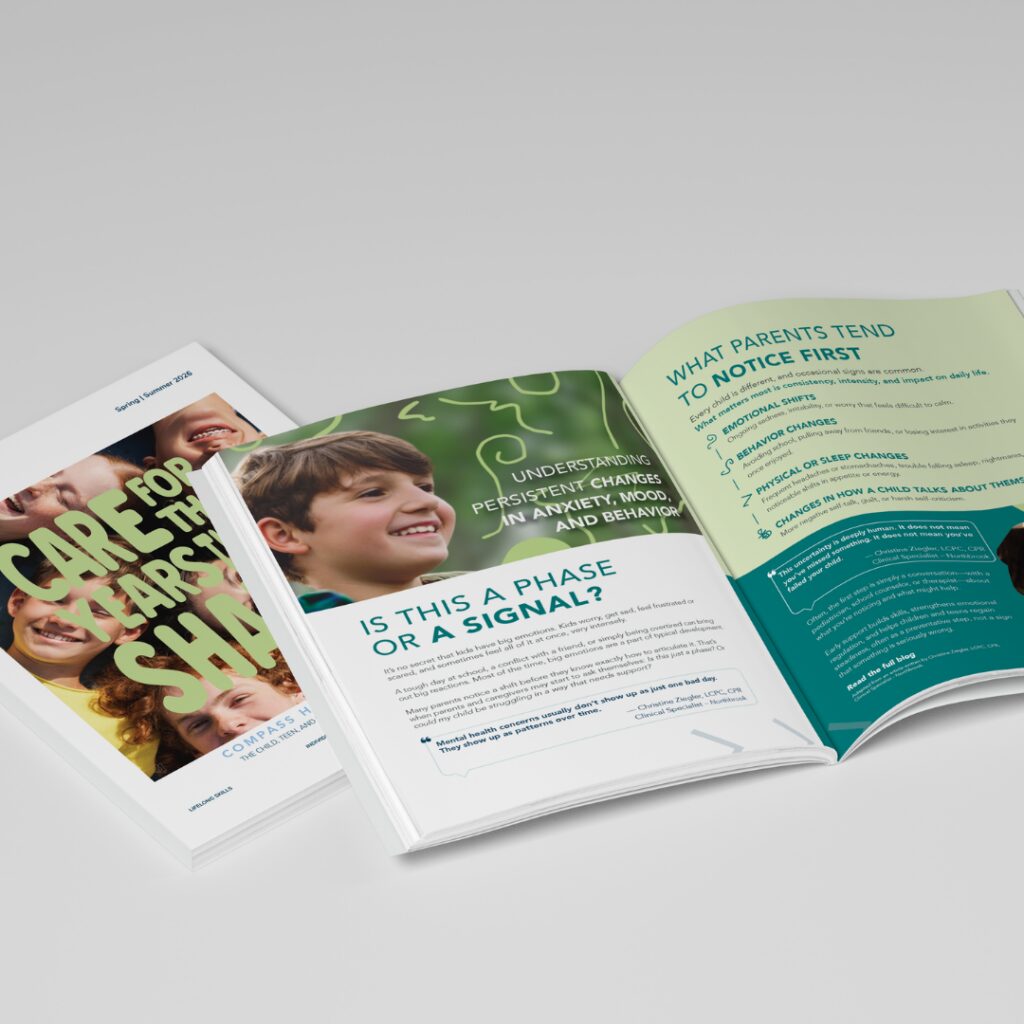
Meet Forward, Compass Health Center’s Lookbook
Mental health care is changing—and so is the way we tell its story.
Forward is a collection of voices, insights, and design that feels less like a brochure and more like a magazine you’d actually want to flip through. We created this Lookbook to show how care can be approachable, engaging, and thoughtfully designed—just as our treatment experience is. Inside, you’ll find our philosophy, programs, and patient outcomes shaping Compass care today, and what’s next.