Episode Description
Kids and teens are figuring out who they are while juggling friendships, school, social media, and family expectations. In this episode, hosts Beth Hope, LCSW, and Britt Teasdale are joined by John Casey, LCSW, Senior Primary Adolescent Therapist at Compass Health Center – Chicago, to talk about how identity and self-concept develop from childhood through adolescence, and how parents can support that process without having all the answers.
They cover the difference between identity and self-concept, how labels help or hurt a child’s confidence, social media’s role in connection and comparison, and how to stay supportive when a child’s identity doesn’t match what a parent expected. John also shares what to do when caregivers don’t agree, and what he wishes more parents understood about a process that’s rarely linear.
Download the Parent Resource Guide Here
Meet the Guest
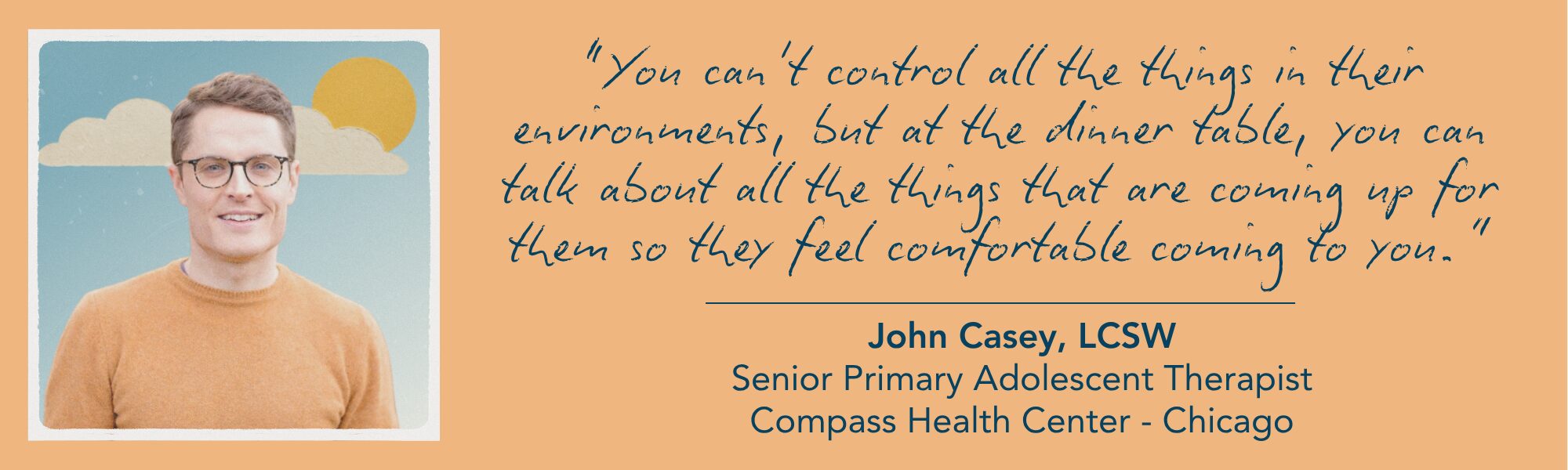
John Casey, LCSW
John Casey, LCSW, has been a social worker for fifteen years, working with children and adolescents throughout his career. He has served as a primary therapist in Compass Health Center’s adolescent program for five years, with additional experience in the child and adult programs. In addition to individual and family therapy, John runs Compass’s gender and sexuality process group for teens as well as the Gender and Sexuality Education Forum for parents, and has led related trainings both internally and externally.
Episode Highlights
The conversation below comes from episode 11 of You Only Know What You Know featuring John Casey, LCSW. The transcript has been lightly edited for length and readability.
What’s the Difference Between Identity and Self-Concept?
John Casey, LCSW: It’s a good question, because they’re related but distinct. When I think of identity, I think of social identity: where I belong, and how things like race, gender, and sexual orientation shape that sense of belonging and how I relate to others. Then there’s personal identity: Who am I, really? That covers likes, dislikes, values, personality traits.
Self-concept is something a bit more abstract. It draws on both of those, but it also gets into self-esteem, self-worth, and the idealized self. That’s especially relevant with teenagers, who are constantly asking: Who was I in the past? Who am I now? Who do I want to be?
How Does a Young Person’s Sense of Self Actually Develop?
John Casey, LCSW: So many things shape it. In young children, you see it in imaginative play: testing out roles, starting to notice how they’re similar to or different from other kids. As kids move into adolescence, they start developing values: what’s important to them, as opposed to a goal, which is something concrete they can work toward.
What shapes those values? Family is a big one — what a child sees modeled at home. But also school, friends, and media: the shows they watch, the books they read, and increasingly, social media. All of that feeds into comparison, and comparison feeds directly into self-concept, self-esteem, and self-worth. It’s a genuinely complex process.
How Much Control Do Parents Actually Have Over Their Child’s Identity?
John Casey, LCSW: Families undeniably shape identity development over time, but there’s only so much you can control once your child is out in the world at school, with friends, and in their community.
What matters most is how you respond when your child tries something new—a new interest, a new value, a new role. Say your kid suddenly gets really into horses. The response you want is: “That’s great, tell me more, let’s explore that.” The goal is to keep the door to conversation open, consistently, so your child feels comfortable coming to you as they keep figuring out who they are. You can’t control everything in their environment, but you can control how safe it feels to talk to you about it.
That said, if your child is drawn to something you’re genuinely uncomfortable with, whether it’s different friends or different interests that don’t align with your family’s values, I’d lead with curiosity over rules. When kids are told flatly “no,” a lot of them just go do the thing anyway. Being curious about what’s drawing them to it, rather than reacting sternly, tends to keep them more open with you long-term.
Why Do Labels Matter—And When Do They Become a Problem?
John Casey, LCSW: Labeling is a natural human tendency. We do it constantly, usually based on what we observe. It’s not inherently harmful, but it can lead to over-identification, which raises the stakes and the pressure. Think of the “star athlete” label: there’s a lot riding on that identity, both within the family and at school.
What we want to foster is a diversity of interests, so a child’s sense of self isn’t resting on just one thing. That way, when failure happens—and it will—there’s something else to lean on. Kids who over-identify with a single role tend to feel failure much harder, because there’s nothing else underneath it to catch them.
What’s Actually Driving So Much Identity Exploration in Adolescence?
John Casey, LCSW: A few things converge at once. Roles and responsibilities get more complex with social life, academics, maybe a first job. At the same time, adolescents are seeking independence, trying to figure out who they are apart from their family, which is a normal but genuinely difficult process.
They’re also thinking abstractly for the first time about their past self, present self, and future self. A five-year-old can answer “what do you want to be when you grow up?” pretty easily. A sixteen-year-old facing “where are you going to college?” is being asked to have already figured out who they are and project that into the future, which is a lot to carry.
What Can Parents Do at Home to Support Healthy Identity Development?
John Casey, LCSW: Something as simple as a regular check-in—dinner table conversation, or whatever that looks like for your family—makes a real difference. Kids are usually working through identity questions on their own first, and they’ll often bring pieces of it to a parent or a friend eventually. How you respond in that moment shapes whether they keep coming back with more.
The biggest thing I’d add is building resilience alongside any label or role your child takes on: helping them internalize “this is hard, and I can do hard things,” rather than resting their whole sense of self on one identity or achievement.
What Are the Warning Signs a Child Is Struggling to Find Their Sense of Belonging?
John Casey, LCSW: Watch for patterns like isolating more than usual, or making disparaging comparisons between themselves and others. Those are signs that something might be making it hard for your child to take the social risks needed to find their people.
Outside support matters here: mentors, in whatever form that takes: a family member, a coach, an after-school program leader. And online communities are part of this too. They’re a mixed bag; there’s real risk in unmonitored spaces, but I’ve also seen plenty of young people find genuine community online. It’s worth having an open conversation with your child about that rather than writing it off entirely.
How Should Parents Support a Child Who’s Exploring Gender or Sexual Identity?
John Casey, LCSW: By the time a young person tells you something about their gender or sexual identity, they’ve usually been sitting with it for a while—sometimes talking about it with friends first, or noticing it at school. It’s not always obvious to parents from the outside.
The most protective thing a parent can do is stay curious and stay nonjudgmental. If your child wants to explore how they dress, or get a different haircut, support that within what’s possible for your family: a thrift store trip, painting their room a different color, whatever the equivalent is. It’s not that a favorite color and gender identity are the same thing, but the supportive instinct behind it is the same: How do I help you feel like yourself? That instinct is what keeps kids coming back to their parents with the harder questions later.
How Does Social Media Shape Identity, For Better and Worse?
John Casey, LCSW: There’s a real upside: seeing yourself represented in media, in all its diversity, can be genuinely affirming for a young person. That didn’t exist in the same way a generation ago.
The downside is that social media is full of curated, idealized versions of people’s lives, and our brains aren’t built to process that volume of comparison. Kids are especially vulnerable to this; getting home from school and doomscrolling for two hours is a very different experience than seeing a magazine once a month. Families need real conversations about screen limits, but also about the fact that what people post isn’t the full picture of their lives. That distinction alone can meaningfully protect a kid’s self-esteem.
What Happens When Parents Don’t Align on How to Support Their Child’s Identity?
John Casey, LCSW: No one’s perfect, and full alignment isn’t always realistic, but it matters. When a child gets a different response from each parent, it can create real identity confusion, and they may start going to one parent consistently over the other, which affects the relationship with both.
When I work with caregivers on this, I try to align them around one shared goal first: you want your child to be healthy and safe. Even when parents have personal discomfort or disagreement about a specific identity question, that shared goal is usually something everyone can agree on. It’s a starting point for figuring out how to show up for their kid together.
What Do You Wish More Parents Understood About Identity Development?
John Casey, LCSW: That it requires freedom to explore and to make mistakes. Kids change their minds constantly; I can’t tell you how many parents have told me about the instrument or sport that turned out to be a “bust” after a big investment. There’s real value in encouraging a kid to stick with something hard, but there’s also real value in allowing for change when something genuinely isn’t right for them.
And above all: respond without judgment. “Thank you for telling me” goes a long way toward keeping the door open for the next conversation—and there will always be a next one.