

When a child or teen is struggling with their mental health, school is wrapped up in nearly every decision. In this episode of You Only Know What You Know, hosts Beth Hope, LCSW, and Britt Teasdale are joined by Sarah Pritz Shields, M.ED., Senior Director of Strategic Partnerships at Compass Health Center, and Dr. Toni Boos, PsyD, licensed clinical psychologist and Director of Child Programs at Compass Health Center – Northbrook. Together, they talk about how families, schools, and mental health providers can work as a team before, during, and after treatment.
Sarah and Toni offer expert advice on when to loop in your child’s school and how much to share, what 504 plans and IEPs mean, how schoolwork works in a PHP or IOP, and what a school re-entry meeting looks like. They also discuss how to handle tricky social questions when a child returns, and what to say to parents who worry about taking their child out of school for treatment.
Download the Parent Resource Guide Here
Meet the Guests
Sarah Pritz Shields, Senior Director of Strategic Partnerships, Compass Health Center
Sarah began her career as a special education teacher and spent about twelve years working in schools. She later joined Compass as Director of Education, supporting children transitioning back to school as well as the teachers and education specialists working with them. In her current role, she builds partnerships with community members, including schools.

Toni Boos, PsyD, Director of the Child Program, Compass Health Center – Northbrook
Toni is a licensed clinical psychologist with nine years of experience in PHP and IOP settings with children and adolescents. Her training includes work as a school psychologist in a public school system, conducting evaluations for special education services, and work in therapeutic schools helping students return to their home schools.
Episode Highlights
The conversation below comes from episode 12 of You Only Know What You Know featuring Sarah Pritz Shields and Toni Boos, PsyD. The transcript has been lightly edited for length and readability.
When Should Parents Tell Their Child’s School About a Mental Health Struggle?
Toni Boos, PsyD: It depends on the case, the family’s comfort level, and the specifics of what’s going on. But I personally don’t feel like it’s ever too soon, or overkill, to let the school team know. Even if a child isn’t at the point of needing formal services, it’s helpful for a teacher to have some extra eyes on that student, especially if there’s a big transition at home, or they’re really struggling socially this year. It helps to have supportive adults in the building who know the warning signs to look for. They can be another added support in the treatment process.
Sarah Pritz Shields: It is scary, and it can feel secretive. When parents ask us about this, we first affirm their feelings about that vulnerability. Then we think about the child: Are they going to be most successful when they have to be secretive about what they’re going through, or when supportive adults who are with them eight hours a day know what’s going on and can help with larger transitions or social difficulties? Almost a hundred percent of the time, it’s better for the school to know.
How Much Should Parents Share with the School, and Who Should They Tell?
Toni Boos, PsyD: You don’t have to share everything. You can be selective about what you feel the school needs to know and keep other things within the family or between you and your outside providers. If there’s something we believe would really be in your child’s best interest for the school to know, we’ll explain the why behind that, but it’s always a collaborative conversation.
Sarah Pritz Shields: It depends on the age. In elementary school, your communication is most often with your child’s teacher. In middle and high school, students have many teachers, so you might connect more with the school counselor or social worker. Start with whoever you feel would be most helpful.
Toni Boos, PsyD: Providers also need signed releases of information before speaking with the school. The form lists what can be shared, like treatment goals, diagnoses, medications, or progress updates, and it’s an open conversation about what you’re comfortable with. You might just share that your child is dealing with some anxiety and would benefit from a couple of breaks here or there. You don’t need to go into family history.
Will Telling the School Lead to Formal Accommodations Like a 504 Plan or IEP?
Toni Boos, PsyD: One fear parents have is “Will my child suddenly have all these accommodations, or get out of things I don’t want them to get out of?” That won’t happen without the parents’ knowledge. There will be meetings and discussions, and you’ll be involved before any formal supports are put in place. It helps to be forward with the school team that you want to be part of the process. Schools really value parent involvement.
Sarah Pritz Shields: Formalized supports means a 504 Plan or an IEP, which are legal documents that outline the supports and accommodations a child might need to access their education. Parents are required to be part of that process. And by and large, people go into education because they want to help kids, so most schools are willing and wanting to partner with families.
Will My Child Fall Behind If They Miss School for PHP or IOP?
Toni Boos, PsyD: This comes up all the time: falling behind academically, the social impact of missing school, and sometimes the worry that taking a child out of a school they love will hurt their self-esteem. Those are very valid concerns. But there’s never going to be a perfect time to miss school for treatment. When PHP is recommended, it’s usually because there are significant safety concerns or the child isn’t functioning in daily life the way they’d want to be. Delaying treatment, even if it means staying in school, can have a detrimental impact.
They might get behind, and there may be a period of catch-up after they return. But we work with the student, the parent, and the school to mitigate that as much as possible. On the social side, you’d be surprised how many kids in your child’s school have gone through something. People notice at first, but they move on to the next thing pretty quickly.
How Does Schoolwork Fit Into PHP or IOP Treatment at Compass?
Sarah Pritz Shields: Every child is assigned an education specialist who carries a caseload, just like our primary and family therapists. Within 24 to 48 hours of a child starting, and with parent and child permission, we reach out to the school to let them know the child is with us and to ask them to excuse their attendance. Attendance rules vary by school and district.
Kids spend a set amount of time on schoolwork from their home school each day, based on age: two 40-minute blocks for ages five to ten, an hour and a half for middle school, and two hours for high school. Some schools say, “We won’t send any work because we just want them to get better.” We push back, because schoolwork is normalizing when PHP can feel scary, and we want kids to be exposed to the work they’ll return to so it isn’t a shock to the system.
Kids are in therapy all day and they’re tired, so we ask schools to send the essential assignments. And if a child comes home exhausted and can’t do homework for the first couple of days, we help parents understand why. We give them space to rest and build stamina, and then we reintroduce homework.
How Do You Know When a Child Is Ready to Go Back to School?
Toni Boos, PsyD: We talk about school throughout treatment, so there are a lot of seeds planted before we schedule a re-entry meeting. We’re looking for new, healthier ways of coping that the child is starting to use, whether on their own or with prompting from adults, depending on their age. We’re looking for a reduction in symptoms and increased safety and stability overall.
Things won’t be perfect. There will still be bumps in the road, and that’s to be expected. But we want to see things on a forward trajectory. Parents and students are part of that conversation too. Sometimes a student will say, “I don’t feel quite ready yet.”
What Happens at a School Re-Entry Meeting?
Toni Boos, PsyD: The meeting typically includes the education specialist and the primary therapist from Compass, the parents, and the school team. Who attends from the school depends on the school and the child’s age. It might be a teacher, social worker, administrator, or an IEP case manager. High school students are usually part of the meeting and vocal about what’s been helpful and what they need. For younger children, we’re their voice.
We recognize that we are not a school. Our environment is milieu-based, and our staffing is very different. So we talk about what helped in our setting and how to adapt it so it’s sustainable for the school team. We also plan the transition itself. Some students ease back in gradually, starting with an hour or a meeting with the social worker. Others want to be back full days right away. Most of the students we work with follow some sort of gradual plan.
Beth Hope, LCSW: The beauty of it is that you know what to expect and you have a say. And if the plan doesn’t feel right once it’s underway, we can change it. We have the bones of a plan, so we’re reducing the uncertainty while keeping it flexible.
What Should a Child Say to Classmates About Where They’ve Been?
Sarah Pritz Shields: We want the child to lead that conversation, not the parents. We ask kids what they want their peers to know and what they want their school team to know. For some, it’s as simple as “I wasn’t feeling well, I went to a place called Compass, and now I’m feeling better.” We do some role-playing where I’m the annoying kid asking lots of questions, so they can practice. Most of the anxiety is really with the adults. Kids care for a little while, and then it’s old news.
Toni Boos, PsyD: The one thing I’ll steer kids away from is an elaborate story, like “I was in Italy.” You’ll get a lot of specific questions, and sustaining that story is hard. Keeping things vague works better: “It was personal stuff,” or “I wasn’t feeling well.” The more details, the more questions. We also ask what kind of welcome they want. Some kids want a big one, and others want the teacher to quietly say, “It’s great to see you.”
Can a Child Keep Participating in Extracurriculars During Treatment?
Sarah Pritz Shields: It depends on the kid and on the school. Some schools have strict rules that if a child isn’t enrolled during the day, they can’t participate in extracurriculars. Others are very flexible. I recently heard about a child who had a role in the school play when PHP was recommended. The play was the one bright spot in their functioning, so the family, school, and treatment team made a flexible plan with some morning IOP days and some after-school IOP days, so the child could stay in rehearsals.
It also might be that going to a football game isn’t helpful right now. If a child’s last experience at a game involved substance use and no supervision, we might say as the adults, “Let’s think about what happened last time and what we want to happen next.” The answer is to have the conversation.
What Do You Wish Parents Knew Before Taking a Child Out of School for Treatment?
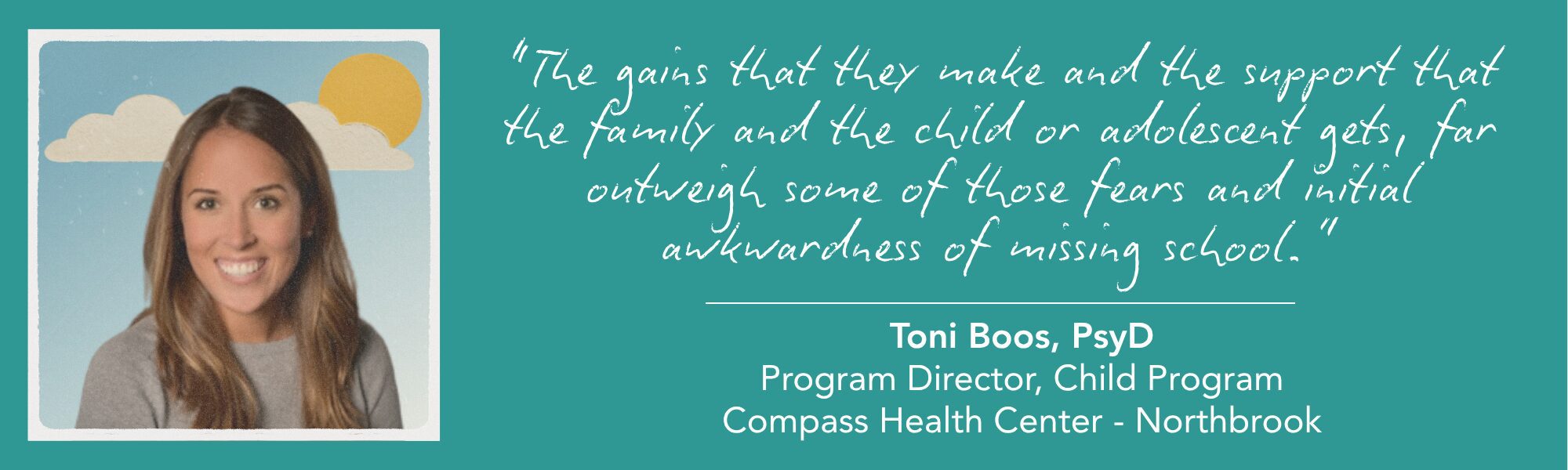
Toni Boos, PsyD: This isn’t a plug for our programs, but I’ve never worked with a family who said things are so much worse because we took them out of school and did this program. There might be bumps, like missed work or navigating social questions. But far more often families say they’re so happy they did it and didn’t delay. The gains the child makes and the support the family gets far outweigh those initial fears.
Sarah Pritz Shields: There’s a quote I think of often as a mom of older teens: development is on our side. Their brains are still developing. They won’t always be unable to turn in their homework independently. No phase lasts forever, and if there’s something you need support with, get it. We’re all trying.
***
Is your child struggling and you’re not sure how school fits in? Compass Health Center’s child and teen programs include a dedicated education specialist for every student and a collaborative re-entry plan built with your family and your school. Learn about our School Anxiety & Refusal Treatment or schedule an appointment.