
Talking with a child or teen about suicide is one of the hardest conversations a parent will ever have, and one many parents put off out of fear of saying the wrong thing. In second installment of this two-part conversation on suicide prevention, hosts Beth Hope, LCSW, and Britt Teasdale are joined by licensed clinical social worker Tina Maltese Gio, LCSW, Senior Director of Child and Adolescent Programs at Compass Health Center in Northbrook, to talk through what suicidal ideation can look like at different ages, how to ask hard questions, and what families need to know during a crisis and in the months that follow.
This episode continues the conversation from Part One, in which Britt shared the story of losing her sister Kat to suicide.
A note before you listen: This episode includes discussion of suicide, suicidal thoughts, and suicide loss. Please take care of yourself as you listen; pause, step away, or come back to it when you’re ready. If you or someone you know is struggling or needs immediate support, call or text the 988 Suicide and Crisis Lifeline, available 24/7.
Meet the Guest
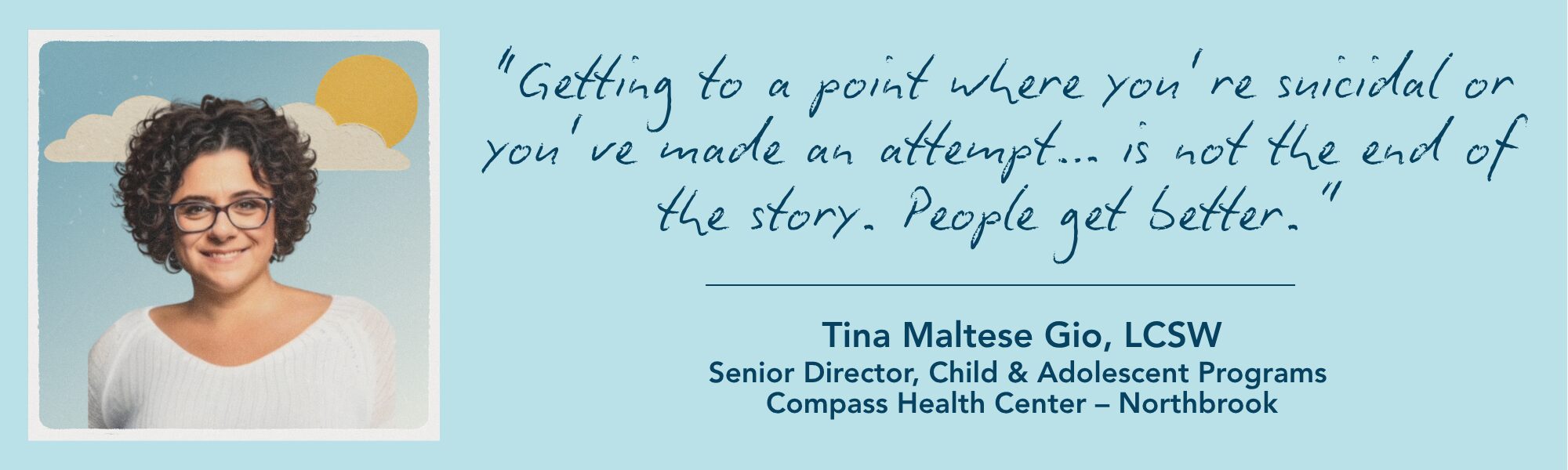
Tina Maltese Gio, LCSW
Tina is the Senior Director of Child and Adolescent Programs at Compass Health Center in Northbrook. With more than 20 years specializing in child and adolescent mental health, including hospital settings, PHP programs, and crisis intervention. She has supported countless children, teens, and families through suicidal crises and other serious mental health struggles.
Episode Highlights
The conversation below comes from Part Two of a two-part episode of You Only Know What You Know featuring Tina Maltese Gio, LCSW. The transcript has been lightly edited for length and readability.
Should parents bring up suicide proactively, even without a specific concern?
Tina Maltese Gio: Kids talk about their mental health with each other a lot more than they used to, and they’re pretty open about it. Sometimes it’s actually us as parents who hesitate, because we worry that bringing it up might put ideas in their head. But the reality is these kids are already talking about it and hearing about it. Us bringing it up just tells them: this is real, and you can talk to me about it. It’s scary, but it’s essential.
At what age should parents start having these conversations?
Tina Maltese Gio: I think it’s important to open those conversations early and often. If you suspect your kid or their friends are struggling, ask. You can’t go from noticing nothing to suddenly asking, “Are you suicidal?” Starting early with smaller check-ins, about changes you’re noticing or things you’re hearing about with friends, opens the door for the harder conversations later.
Can you define some key terms parents should know?
Tina Maltese Gio: Self-harm or non-suicidal self-injury—cutting, burning, that kind of thing—is often about releasing pain rather than wanting to die. Suicidal thoughts or suicidal ideation is when someone is actually thinking about suicide, whether that’s not wanting to live anymore or having a plan or intent. And a suicide attempt is when someone takes action to try to end their life.
What if a child or teen says something like “I want to die” in the heat of an argument?
Tina Maltese Gio: It shouldn’t be ignored, even if it’s said in anger or frustration. There’s usually something else going on. I’d go back later and say, “You said this earlier, and I’m a little concerned. What was going on in that moment?”
Even if they didn’t mean it literally, there’s emotion behind those words that’s worth understanding. It’s also worth asking directly: do you feel like you can talk to me, or would you rather talk to someone else: a therapist, a counselor, someone at school?
What about younger kids, ages five to eight, who use words like this without fully understanding them?
Tina Maltese Gio: Some genuinely don’t know what the words mean; others do. I’d ask what they meant when they said it, and also help them understand that those words are scary for other people to hear. Framing it as “when I hear you say that, it makes me scared or sad” can open the door to what’s really going on, without making the child feel like they did something wrong.
If a young child asks what “suicide” means, how should a parent explain it?
Tina Maltese Gio: I don’t think we need to go into full detail with our youngest kids. I’d explain it in medical terms—that sometimes people have an illness or sickness in their brain that makes them very sad, and that can lead to their death. That tends to be a little easier for a young child to digest than describing it more literally.
Is there a right age to tell a child that a relative died by suicide?
Tina Maltese Gio: There’s no exact guideline; you know your child. By upper elementary or middle school, kids are usually going to hear about it somewhere, and if you’re not being truthful, they’ll sense that. Older kids do need the actual truth eventually. It might sound like: “this was a struggle for them for a long time, and maybe they didn’t get help,” or “they tried and it was still really hard.”
If a child tells a parent they’re having thoughts of suicide, what should the parent do next?
Tina Maltese Gio: Start by asking questions: how long has this been going on, what’s changed. If you’re uneasy with the answers, reach out for help: an outpatient therapist, or if there seems to be an actual plan or you feel this is imminent, the emergency room. It’s hard to ask your own child questions like, “Are you having thoughts of suicide? Do you want to die?” but it’s essential. If they say yes, ask what they’d do, whether they’ve thought about a plan. If there’s an answer to that, it usually means a more extensive evaluation is needed, often at an emergency room.
What questions help a parent understand how urgent a situation is?
Tina Maltese Gio: Ask what triggered it and how long it’s been going on. Ask if they’ve thought about what they would do, and if they’ve ever actually tried or made a plan to hurt themselves before. As parents, you don’t need to go further than that or conduct a full clinical assessment. Clinicians are the ones asking about plan, intent, and access to means. Your job is to gather enough information to know what to do next, not to do the full evaluation yourself.
What’s the right next step once a parent has that information?
Tina Maltese Gio: A phone call anywhere—with an existing therapist, your own therapist if you have one, or your pediatrician—can help you decide. The important thing is calling someone who knows what the next step should be, so you’re not making that decision alone. There are more options than just the emergency room, though that’s absolutely appropriate too if it’s what’s needed.
What if a teen won’t talk to their parent at all?
Tina Maltese Gio: Keep trying, but also enlist people they trust, like a family friend, a school counselor, a teacher. You can also use a routine opportunity, like a yearly physical, where teens typically meet with the pediatrician alone and often go through a depression screening. Friends often know the most, too, and having a conversation with them (without breaking a teen’s trust unnecessarily) can help. For kids who shut down verbally, writing things down in a notebook passed back and forth can sometimes work when talking doesn’t.
What are some signs parents should watch for?
Tina Maltese Gio: Withdrawing from friends or family, increased irritability or anger, issues with friends or bullying, feelings of hopelessness, dropping grades, general disengagement, and increased risky behavior or substance use. A lot of times kids turn to those behaviors because they’ve stopped caring about what happens to them.
How do you tell the difference between typical teen moodiness and something more serious?
Tina Maltese Gio: Teenagers are moody by nature. The difference is when it stops being intermittent ups and downs and starts to look more like despair, which looks like a real departure from who they normally are, paired with changes in sleep, appetite, friendships, and grades. When you see multiple things stacking up together, that’s a bigger signal.
Is self-harm itself a warning sign for suicide?
Tina Maltese Gio: Self-harm indicates significant mental health struggles that need to be addressed, but it doesn’t necessarily mean someone is suicidal. Self-harm is often more about releasing pain than wanting to die. It’s serious and shouldn’t be ignored, and it’s worth checking in with a therapist or pediatrician about, but it isn’t automatically an emergency-room situation the way an active plan or intent would be.
How should parents think about kids and social media, especially with stories in the news about extortion and bullying leading to tragic outcomes?
Tina Maltese Gio: It can happen on any platform, and it’s not always an outside stranger. Sometimes it’s bullying from kids at school playing out in a group chat. I’d encourage opening communication, knowing what’s going on, and using monitoring tools if you’re concerned. Limiting screen time helps too, though it’s a balancing act since so much of teen social life now happens through texting and apps. It’s okay to check a phone or use a monitoring app if you’re worried.
What about kids turning to AI chatbots for emotional support or as a substitute for therapy?
Tina Maltese Gio: This has come up more than I expected. I’d have an honest conversation about what’s real and what isn’t. AI gets things wrong, and it isn’t a person. A chatbot is not a therapist and isn’t an equal replacement. The appropriate places to turn are a school counselor, a therapist, a crisis line, or another trusted person.
How does suicide loss affect the rest of the family?
Tina Maltese Gio: It affects everyone, often with a layer of guilt; wondering if you should have known, said something different, done something different. Open communication as soon as possible matters, and so does bringing in outside support, since a grieving parent may not have the emotional bandwidth to be fully present for their other children right when they need it most.
How much should parents tell siblings about how a family member died?
Tina Maltese Gio: Start by asking what they already know, rather than assuming. Then approach it in an age-appropriate way, without necessarily going into full detail, especially with younger kids. But don’t leave their questions unanswered either.
What does grief look like in siblings, and when should parents be more concerned?
Tina Maltese Gio: It can look like withdrawal and quietness, or it can look like acting out and behavioral issues—it varies by the child. The kids I worry about most are the ones who aren’t talking at all or acting like nothing happened. Getting them talking, in whatever way works for them, is the most helpful thing.
How can parents support other siblings when one child needs significant mental health attention?
Tina Maltese Gio: Be intentional about carving out time and naming what’s happening. Something like, “I know your sister has needed a lot of my attention, and I want you to know I’m here for you too.” Small, regular check-ins help siblings feel seen even amid a family crisis.
What makes grief after a suicide loss different from other kinds of grief?
Tina Maltese Gio: It feels more personal. There’s often a layer of guilt that doesn’t show up the same way with, say, a sudden heart attack or a long illness. It’s often unexpected, even when you knew someone was struggling, and it brings up hard questions: How bad did it have to get? Could I have done something differently?
How can families move past the fear of being judged after a suicide loss or attempt?
Tina Maltese Gio: That fear is valid and common, but depression is a severe, biological, chemical illness; it isn’t something a family caused or something anyone should be ashamed of. When it comes to supporting a family after a loss or an attempt, treat it like you would any other serious illness: show up, make the call, send the text, stop by. Don’t disappear because you don’t know what to say; that isolation feels worse than an imperfect gesture.
How can families keep the memory of someone alive as a whole person, rather than defined by how they died?
Tina Maltese Gio: It takes real grief work—therapy, talking with family—to get to a place where you can look back and see the whole person and their whole life again. Once you can, telling the fun stories and sharing memories whenever they come up is what keeps who they actually were at the forefront.
What gives you hope in this work?
Tina Maltese Gio: That struggling, even reaching a point of suicidal thoughts or an attempt, isn’t the end of the story. We’ve seen kids who were hospitalized multiple times go on to give graduation speeches and build successful lives, and some reach back out years later to say treatment made a real difference. Treatment works, and meeting kids where they are can change the entire trajectory.
What would you say to a family that’s grieving right now?
Tina Maltese Gio: You did the best that you could. That’s all any of us can do as parents: see as much as you were able to see, and help as much as you were able to help. Give yourself grace.
This article is based on a conversation from the You Only Know What You Know podcast, hosted by Beth Hope and Britt Teasdale, featuring Tina Maltese Gio, LCSW, Director of Child and Adolescent Programs at Compass Health Center – Northbrook.
The information shared here is intended for general education and shouldn’t replace medical advice from your child’s healthcare provider. If you have questions about your child’s mental health or treatment, talk with your pediatrician or a psychiatric provider.