
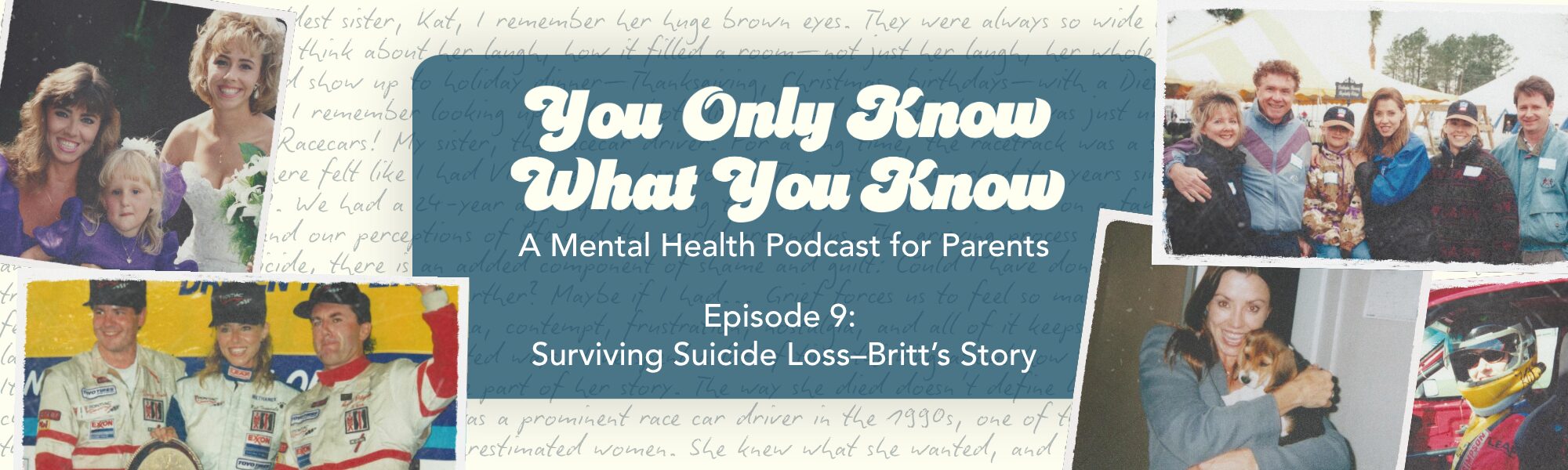
Remembering my sister beyond her suicide and reflecting on grief and suicide loss during Suicide Prevention Month
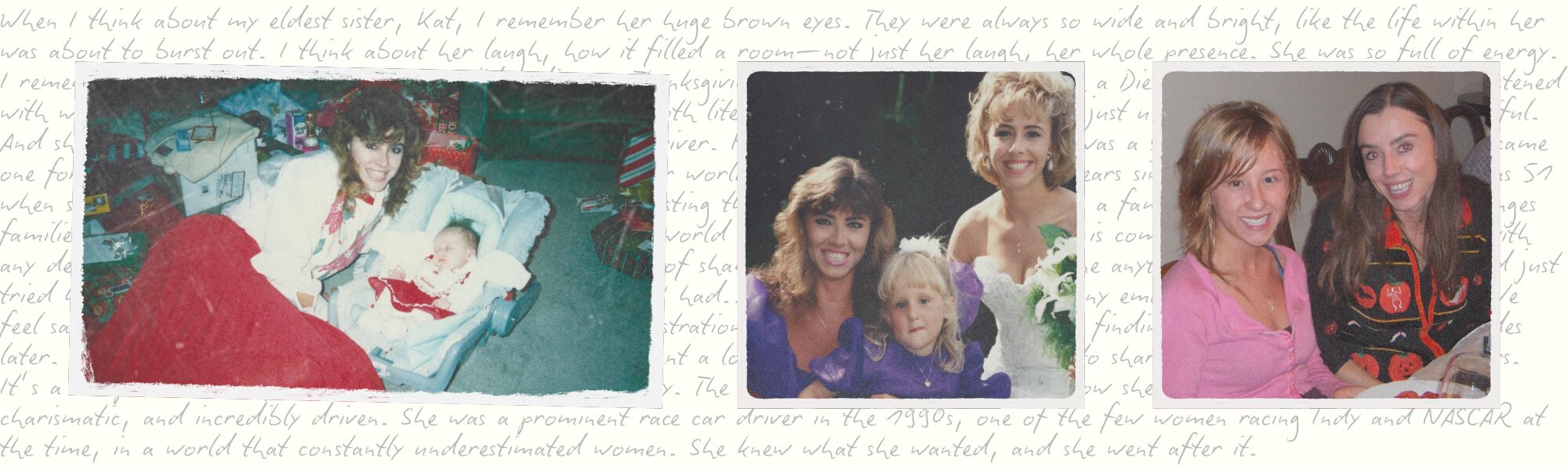
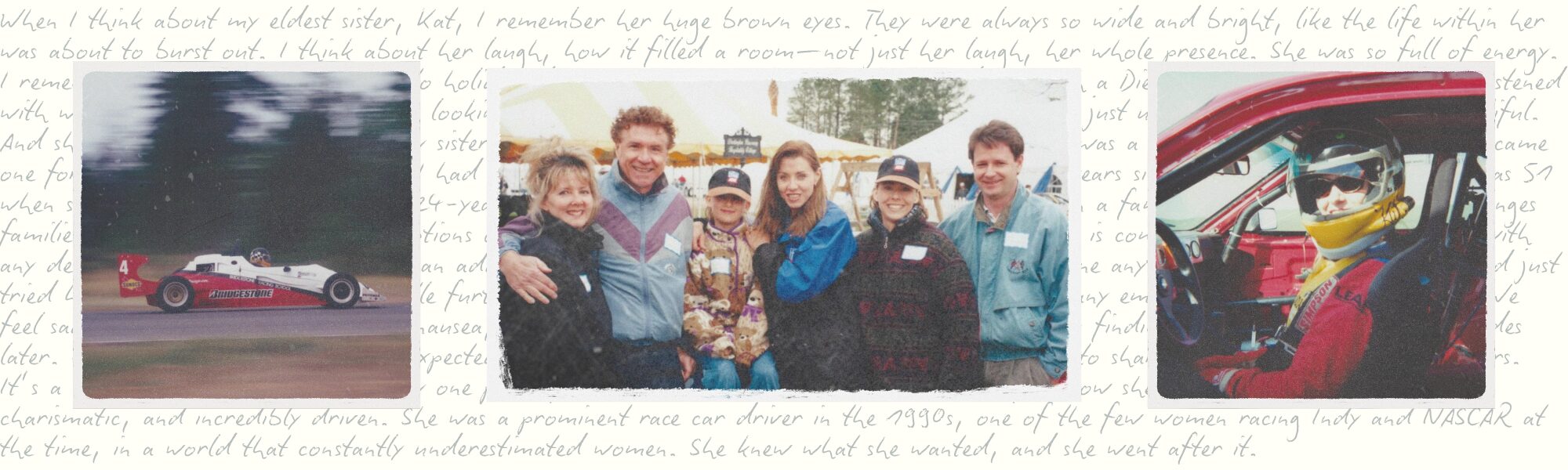
When I think about my eldest sister, Kat, I remember her huge brown eyes. They were always so wide and bright, like the life within her was about to burst out. I think about her laugh, how it filled a room—not just her laugh, her whole presence. She was so full of energy. I remember the way she’d show up to holiday dinner—Thanksgiving, Christmas, birthdays—with a Diet Coke in hand and presents fastened with way too much tape. I remember looking up to her, both literally and figuratively. She was just under six feet tall and so beautiful. And she drove racecars. Racecars! My sister, the racecar driver. For a long time, the racetrack was a special place for her, and it became one for me too. Being there felt like I had VIP access to her world.
This past June marked ten years since Kat died by suicide. She was 51 when she died. I was 27. We had a 24-year age gap.
The sting that suicide loss leaves behind on a family never stops burning. It changes families, relationships, and our perceptions of life and the world around us. The grieving process is complicated and painful, as it is with any death, but with suicide, there is an added component of shame and guilt:
Could I have done anything differently?
What if I had just tried harder?
What if I pushed a little further?
Maybe if I had…
Grief forces us to feel so many emotions and sensations at once. We feel sadness, anger, love, confusion, nausea, contempt, frustration, nostalgia, and all of it keeps finding us months, years, and decades later. Grief speaks to you in such unexpected ways.
I’ve spent a lot of time thinking about how to share this part of my life, and hers. It’s a complicated story, and it’s only one part of her story. The way she died doesn’t define how she lived.
Who Kat was
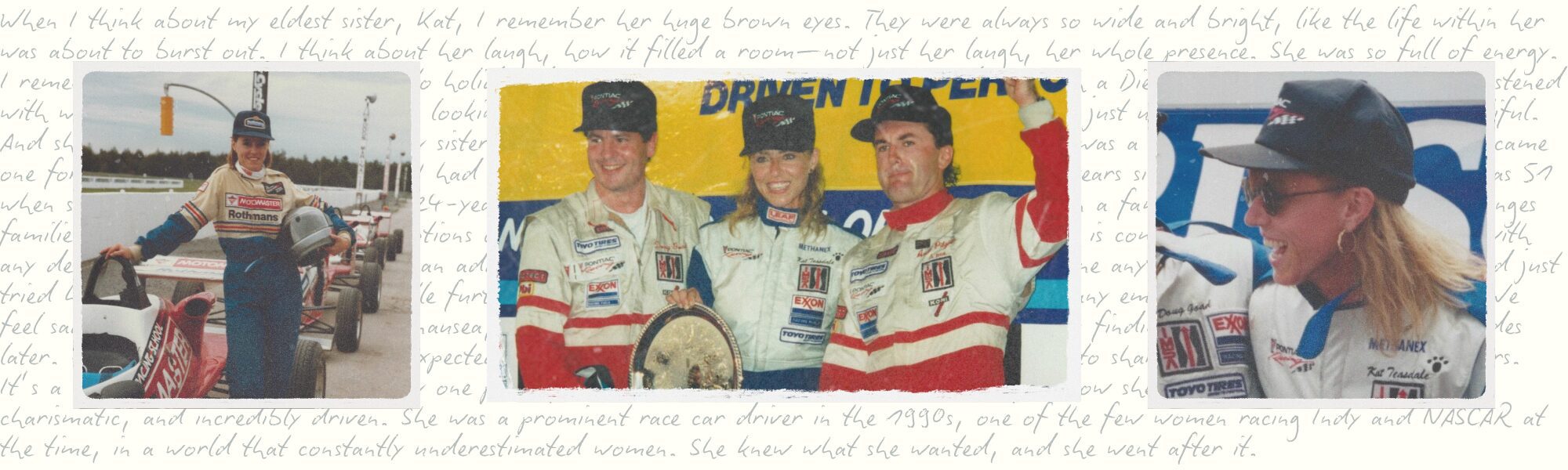
Kat was determined, charismatic, and incredibly driven. She was a prominent race car driver in the 1990s, one of the few women racing Indy and NASCAR at the time, in a world that constantly underestimated women. She knew what she wanted, and she went after it.
There were many sides to Kat, and I don’t want the determined, remarkable side of her to get discounted by the fact that she also struggled with her mental health for a lot of her life. I didn’t see much of that struggle as a kid, and it wasn’t until my teenage years that I started to understand the different facets of her life. Kat never talked to me directly about what she was going through. I think she was proud and private, and it was hard for her to share what she was experiencing. What I knew, I learned from my dad and our sister, Karen. My dad had tried to get her professional mental health support throughout her life; unfortunately, she was resistant to it. To love someone is to want to see them well and healthy, so when they refuse the help they need, it can be especially heartbreaking. I think anyone who has loved someone struggling with their mental health or addiction may relate to this friction.
In the last few years of her life, she became estranged from parts of our family. We couldn’t really tell how much support she was getting near the end, but I don’t think it was much. She wouldn’t let me get close. At some point she also developed Lyme disease, which is frequently misunderstood and misdiagnosed, which I believe made everything she was already struggling with worse. She retreated from most of our family. I sent her a birthday card every year; her birthday was Christmas Day. At some point, I stopped getting a response.
How I found out
I was on a holiday in South Carolina with one of my best friends when my dad called and told me. We’d gotten in late the night before. I remember standing or sitting with my friend in our hotel room, and neither of us knowing what to say or do. I think she may have hugged me. Her face was pale. There wasn’t anything to say or do. It felt surreal, like I couldn’t even find the words to acknowledge what had just happened.
Eventually, we went out for breakfast because we decided we needed to eat something—Denny’s. I remember pushing my food around a plate, the yellowy-orange yolks of my eggs breaking, with a gush at first and then slowly oozing onto the white plate. I thought I might throw up. I’m surprised I didn’t. It felt like I was floating through a dream, one where you’re unsure if it really is a dream or if you’ve already woken up.
I was lucky to have my friend there with me. Another close friend arrived later that day, and I got to be with them as I tried to process the news. This mostly involved dissociating, like I was watching some tragic movie. Surely Kat was still alive, I thought to myself more times than was probably considered healthy. How could she not be?
My experience with guilt
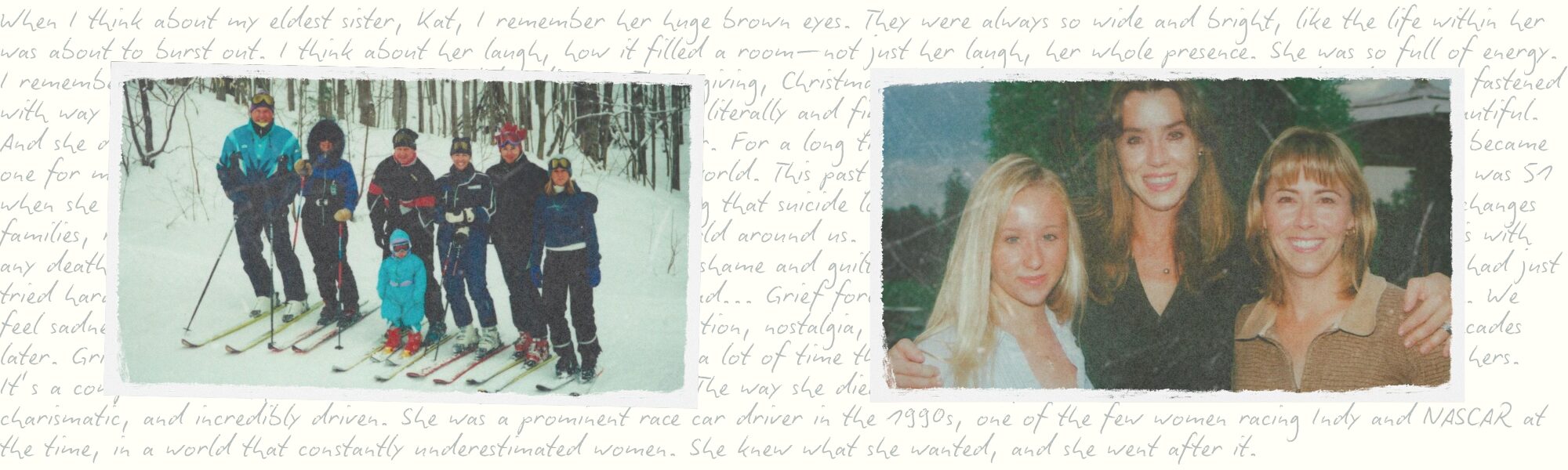
For a long time after Kat died, my family had a hard time talking about the way she died. I think we felt something close to shame or guilt, that feeling when you think you could have done something more to stop a tragedy. Not quite regret. More like: what could I have done to prevent this? This kind of guilt comes specifically with a suicide loss, and it keeps individuals and families from talking about their loss for a long time.
Now working in mental health—and with therapy and time—I know that it’s not my fault Kat died, and it’s not anyone’s fault. My rational mind knows that. But my emotional mind still feels guilt sometimes. I think that’s important for anyone supporting a suicide loss survivor to understand: the person next to you is probably feeling a lot of guilt and shame, and they might not know what they need from you. Sometimes what helped me most didn’t come from conversation. It wasn’t anyone needing to have the right words. It was just having people physically there with me.
Becoming a parent changed how I understand my dad’s experience of losing a child this way. At the time, I didn’t understand how a parent would feel. Now I can’t imagine what he was, and still is, feeling. The pain is unimaginable.
Ten years later
In the first year or two after Kat died, I couldn’t talk about her at all, and I think that made the people around me afraid to ask. Suicide feels taboo. For me, the fear of talking about Kat’s death is changing shape. I’m able to talk about it, even when it’s painful.
The ways in which grief shows up still surprise me. For a while, immediately before (because we were estranged) and after she died, I’d think I saw her at the grocery store, places like that. It happened a lot right after, but it hasn’t in a long time now.
Christmas is still the hardest day for me when it comes to remembering Kat. It was her birthday, and the last real conversation I had with her—a hard one, not a great one—was a phone call on Christmas Day, a few years before she died. I remember sitting on the floor of my boyfriend’s parents’ chalet and feeling like I was slowly getting heavier, sinking into the carpet. Christmastime hasn’t gotten easier.
The anniversary of her death has changed for me over the years, though. The first few years were just so sad. Now there’s more room alongside the sadness and complicated history to remember the happy memories and honor her life.
My family talks about Kat and the way she died more now, too. My dad, who is in his mid-80s and comes from a generation where mental health wasn’t discussed at all, was recently interviewed for a short documentary being made about her life and death—it’s called “A Trailblazer’s Legacy.” Watching him participate in the documentary and speak on behalf of our family has meant a lot to me. I’m definitely having a major ‘proud daughter’ moment.
Why I do this work
Kat died in June 2016, and I started at Compass Health Center the following year, April 2017. Working on the brand side of the organization and telling the stories of the people we treat and the work our clinicians do helps me feel connected to my sister. Being part of the mental health treatment world, even from behind the scenes, has felt like a way to honor Kat’s life and what she struggled with. Growing up, I never heard of a level of care that existed between “see a therapist” and “go to an inpatient hospital.” When I learned what Compass does—partial hospitalization and intensive outpatient programs—I thought about how much it may have changed the trajectory of her life, if that kind of option had been accessible to her, and she had been willing to try it.
Supporting someone through a suicide loss
If you’re supporting someone through a loss like this: they’re probably carrying guilt, even if they know they shouldn’t. They might not know what they need. But being there, even without the right words, matters more than you think. What helped me most in those first days wasn’t anyone saying the right thing. Just having my friends physically there: one sitting with me in that hotel room, another showing up with a hug and a plan for the day. That’s all I needed in that moment.
For survivors of suicide loss
If you’re the one carrying this type of loss: talking about it, when you’re ready, can open up connections you never in a million years would think existed. I recently learned that my mom’s best friend died by suicide when they were teenagers. I never knew that until I started talking more openly about Kat. People are holding these losses close to their hearts more often than we realize. It’s overdone, but cliché and comforting for a reason: you are not alone.
So let me tell you a little more about Kat here before you go. My sister is so much more than the way she died. She’s the downhill ski racer who injured her knee and pivoted to a career in professional racecar driving. She’s the big sister who’d take me out for a drive on the track, and I thought she was the absolute coolest. She’s the sister who sometimes showed up to family dinners looking a bit disheveled and hyper, and I didn’t understand why. She’s the sister who broke her nose multiple times racing cars, eventually retired, and then pivoted to pursue sports public relations. She’s the fun, wild sister. She’s the sister who pushed me away. She’s so many things, and the least interesting thing about her is how she died.
I’d love more chances to talk about her and try not to let her suicide overshadow so much of remembering her. It’s hard not to let it. If you’ve experienced a loss like this and it feels like a burden to talk about, I bet your loved ones don’t see it that way. If it feels right for you, open up. And if you don’t, you’ll know when you’re ready. Trust yourself and the timing that feels right for you.
Hear more of my story on You Only Know What You Know
Talking openly about suicide loss can be difficult. It can also be an important part of grieving and remembering the person we lost. In the latest episode of You Only Know What You Know, my co-host Beth Hope, LCSW, sits down with me to talk about my experience losing my sister to suicide, including what grief has looked like over the past 10 years and my reflections on how others can support someone who has experienced a suicide loss.
Sometimes, the more we open up to people we trust about the hard stuff, the more connected we can feel. I don’t know about you, but the older I get, the more I realize that everyone has a hard story or two, and most of us just want a friend who will sit with us in it.
If you’re struggling: If you’re having thoughts of suicide, or you’re worried about someone who might be, call or text 988 (Suicide & Crisis Lifeline), available 24 hours a day. If you’ve lost someone to suicide, the American Foundation for Suicide Prevention and Alliance of Hope for Suicide Loss Survivors offer survivor-specific support communities.
Further reading, remembering the life of Kat Teasdale: