Forward Lookbook Issue 02: Kids, Teens, and the Developing Brain — What Parents Should Know About Mental Health
What Teenage Brain Development Means for Mental Health Support
Childhood and adolescence are a critical window for mental health support. Drawing on the field of child and adolescent psychiatry, this post explores how the developing brain shapes emotion regulation and stress, when weekly therapy may not provide enough structure, and what more intensive levels of care can look like for families navigating this stage. It also introduces Forward Lookbook Issue 02, a resource designed to support parents and clinicians through these years.
Why These Years Matter: The Window That Shapes a Life
Every day, families share their experiences at Compass Health Center. Over time, those insights and clinical outcomes start to form a pattern. The data helps put it into words.
75% of mental health conditions begin before age 24.
Childhood and adolescence are the years when identity takes shape, when emotion regulation is still developing, and when patterns around coping, avoidance, and resilience are forming in real time. When treatment meets this phase of life with the right level of structure and support, meaningful change is very possible.
Compass Health Center outcomes data reflect what we see clinically every day. Patients who complete our programs can experience a:
- 56% reduction in depression symptoms
- 55% reduction in anxiety symptoms
- 44% reduction in OCD symptoms
- 54% reduction in trauma symptoms
And importantly, those changes tend to last.
- 90% of patients maintain their progress and do not require higher levels of care for 12 months or more
- 95% step down to a lower level of care after treatment
The data helps explain something families often feel long before they can articulate it. These years matter, not just because they are hard, but because they are still open to change.
When Something Feels Off
There’s a point many families reach where something doesn’t quite add up, even if nothing looks wrong from the outside, and there’s no single moment you can point to as the reason.
If you’re a parent, you’ve been paying attention, probably more than anyone else. You’ve tried to respond thoughtfully to tension or friction. Maybe you’ve started weekly therapy, connected with your child’s school, had ongoing conversations at home, and done all of the things that are supposed to help.
And still, there’s this persistent feeling that things aren’t really changing in the way you hoped they would.
This can be the moment when families start to wonder what they’re missing, or whether they’re overreacting, or whether they just need to give it more time. The reality is, this is also when the path forward looks the least clear. Weekly therapy can start to feel like it’s not quite enough, but more intensive options can feel like too big a step. What exists in between is often effective, but it’s not always obvious until you’re already looking for it.
Why These Years Matter
Part of what makes this stage of life so complicated is that childhood and adolescence are when so many things are changing, and often nothing feels like it’s moving in a straight line.
They are ongoing phases of development, where a lot is still taking shape emotionally, mentally, and physically in ways that aren’t always obvious day to day. There are also so many external factors and transitions that may make this stage feel even more out of control: divorce, family relocation, puberty, college applications, and so much more.
How Teenage Brain Development Affects Emotion Regulation
Research on teenage brain development shows that the brain is still developing systems for emotion regulation, impulse control, and decision-making, which is why things can feel inconsistent at times, even for a young person who wants to feel better and is working on their mental health. One day might feel manageable, the next much less so, and that variability can be confusing for everyone involved. Hormones play a big role in this, especially for teenagers.
As a bystander, this can look like avoidance, or lack of effort, or not trying hard enough, but more often than not, what’s actually happening is that the capacity to manage what they’re experiencing is still developing.
Because this stage of development is so malleable, it is highly responsive to the right kind of support, especially when that support is consistent enough to help new thinking patterns take shape.
We’ve all heard that practice makes perfect, and although that is a simplistic way to think about this, and perfection isn’t the goal, there is truth in that statement. What gets practiced repeatedly, positive or negative, during these years is more likely to stay with a person into adulthood, not just in behavior, but also in how they come to understand themselves and respond to stress, uncertainty, and challenge over time.
A Psychiatrist’s Perspective
This is the lens that grounds Issue Two of our lookbook, Forward, and it’s what makes Chris Womack, MD’s letter such an important part of it.
As a specialist in child and adolescent psychiatry and Medical Director at Compass Health Center, Dr. Womack’s perspective centers on adolescent brain development during these years and how often that development gets misunderstood when a young person is struggling.
He writes about something many families already sense, even if they don’t have the language for it: that when something feels “stuck,” it’s rarely about motivation alone for that child. It often comes down to capacity.
Capacity is not something a young person either has or doesn’t have. It can be built, especially during this window when the brain is still learning how to regulate and respond to what it’s experiencing. With the right level of treatment and the introduction and repetition of coping skills, those systems can develop in a more lasting way.
When Weekly Therapy Isn’t Enough
Sometimes families have found a therapist they trust, worked with the school, stayed engaged even when it’s been exhausting or uncertain, and kept showing up for their child or teen in ways that matter. Sometimes, that’s enough to create improvements over time.
Other times, progress levels off in a way that feels confusing, especially because everyone involved is still trying. That’s often the moment where doubt starts to creep in, or where families begin to wonder if they’ve missed something along the way.
What we see, over and over again, is that this doesn’t mean something is fundamentally wrong with the child or teen. It usually means the level of support isn’t quite aligned with what they need right now, particularly if what they’re dealing with requires more consistency, more structure, and more opportunity to practice skills in real time than weekly sessions can offer.
More structured adolescent mental health services create space for that kind of practice to actually happen in a way that’s supported and adjusted as things shift. That’s where in-between levels of care, like Partial Hospitalization (PHP) and Intensive Outpatient (IOP), can be a good fit if symptoms are impacting daily life—not as a last resort, but as a way to meet a moment that hasn’t responded to less intensive support. Families exploring adolescent mental health services often find that this level of structure provides the consistency their child or teen needs to make lasting progress.
What the Goal Actually Is
Of course, part of the goal is symptom relief—feeling less anxious, less overwhelmed, more able to get through the day without everything feeling so hard is important.
At the same time, what we’re really working toward is something that tends to unfold more gradually: helping a young person start to experience themselves differently in their day-to-day life. More capable. More steady. More able to tolerate what’s hard without it taking over completely.
When that shift begins to happen during these developmental years, it doesn’t just change the moment someone is in. It has a way of carrying forward, shaping how they approach challenges, relationships, and themselves over time in a way that feels more sustainable.
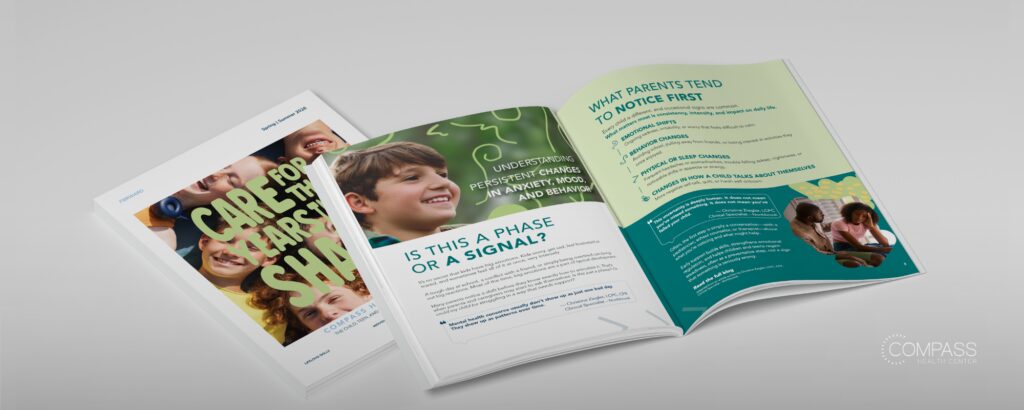
Inside Issue Two
Issue Two of our lookbook, Forward, takes a closer look at this stage of development and what it means to support it well, especially when things don’t resolve with weekly therapy alone, and families are left trying to figure out what comes next.
It brings together clinical perspective, family context, and a more grounded understanding of what in-between care can actually look like in practice, without oversimplifying what’s often a complicated experience.
If you’ve been trying to make sense of what you’re seeing, or are looking for a way to understand what might help, it’s a place to start.