
Q&A with Beth Calvert, PMHNP-BC: Delivering Compassionate, Psychiatry-Led Mental Health Care in Wisconsin
As Compass Health Center expands access to psychiatry-led care across Wisconsin, Beth Calvert, PMHNP-BC, plays a central role in delivering evidence-based, patient-centered treatment for individuals and families navigating mental health challenges. With more than two decades of nursing experience spanning emergency, medical, and behavioral health settings, Calvert brings a thoughtful, integrated approach to her work.
In this conversation, she reflects on her path to becoming a psychiatric nurse practitioner, how Compass’s Partial Hospitalization (PHP) and Intensive Outpatient (IOP) programs in Brookfield meet the state’s growing mental health needs, and why collaboration across disciplines leads to stronger, more sustainable outcomes for patients.
This interview has been lightly edited for grammar and flow. The speaker’s original meaning and intent have not been changed.

Q&A
Britt Teasdale: Can you share your background and what led you to become a psychiatric nurse practitioner?
Beth Calvert, PMHNP-BC:
I began in mental health as a Certified Nursing Assistant (CNA) in a county facility. After moving out of the area, I accepted a position as a CNA on a Women’s Health Unit for a large hospital system. A year later, I transferred within the organization and became a Mental Health Tech in an inpatient setting.
Wanting to expand my knowledge and career in healthcare, I pursued my associate’s degree in nursing (ADN). While I valued my psychiatric experience, I also wanted to gain more medical knowledge, so I transitioned to the emergency department as an ER Tech. After several years of schooling and work in the ER, I advanced into an ER Nurse role, where I remained for 13 years.
Eventually, I took on a leadership opportunity as a House Supervisor and Interim Manager on a cardiac/ICU unit while completing my bachelor’s in nursing. During that time, I realized how much I missed direct patient care. Leadership wasn’t where my passion truly was, so I decided to pursue my master’s degree. I discovered the Psychiatric Nurse Practitioner role—though there were limited programs available at the time—and was fortunate to find an online program that fit.
From my first week in this role up to today, I’ve never looked back. I’m so grateful I pushed myself to get here. I don’t even consider this a job—it’s an honor to work in this field and to support others during some of the hardest times in their lives.
BT: What inspired your interest in mental health and integrated care?
BC:
While I was in my master’s program, my daughter—four years old at the time—struggled with anxiety. She once asked me, “Mommy, are you going to help kids like me?”
Helping her find the right evaluation and diagnosis was challenging. We first went through medical assessments to rule out physical causes. She was evaluated by the GI team at Children’s Hospital. After several tests came back negative, they recommended an upper endoscopy, which I declined.
By second grade, she was still struggling, and I felt lost in the cracks of the healthcare system. We returned to her pediatrician and started a low dose of an antidepressant. Once she reached a therapeutic dose, it was incredible to see her re-engage at school and with friends.
That experience showed me how difficult it can be to access mental health care—and how much it’s needed. Primary care providers are overwhelmed, and mental health requires specialized attention. I believe PHP and IOP programs fill that essential gap between inpatient and outpatient care.
BT: How has your career evolved leading up to your work at Compass?
BC:
After completing my MSN degree—23 years into my nursing career—I left the large hospital system and accepted a Psych NP position in PHP/IOP levels of care. I worked with both adults and adolescents across various programs, including depression, mood, OCD, and anxiety.
During those 5.5 years, I learned so much from incredible colleagues and gained valuable experience, but I felt something was missing. I wanted to join an organization whose mission and values aligned with my own approach to patient care. That’s when I found Compass.
BT: What does your day-to-day look like as a psychiatric nurse practitioner at Compass?
BC:
Before programming begins, all clinical staff gather for a daily huddle—about 10 to 15 minutes—to discuss clinic coverage, safety needs, shout-outs, patient attendance, discharges, and admissions.
I then attend adult rounds with clinical supervisors and therapists to review treatment updates. Once patients begin their programming day, I prioritize evaluations based on safety concerns, medication needs, or new assessments. I keep a tentative schedule of patients I plan to see, along with family sessions, but flexibility is key since each day can shift.
At the end of programming, the adolescent clinical team meets for rounds to review updates. Throughout the day, I also connect with outpatient providers to coordinate ongoing care and ensure continuity after discharge.
BT: How do you collaborate with therapists, family therapists, and group leaders within the PHP/IOP model?
BC:
Much of our collaboration happens in rounds and through active communication. Each patient’s treatment team has a dedicated Teams chat for updates that need attention between rounds. I also collaborate directly with individual team members after therapy or family sessions to discuss treatment progress.
BT: What do you think differentiates Compass’s psychiatric care from other treatment settings?
BC:
The intake process stands out—patients and parents meet with a master’s-level clinician for assessment and can often begin treatment the same or next day. Compass also emphasizes strong collaboration with the community, including outpatient providers, from admission through discharge.
Treatment is evidence-based, and program length is guided by outcome measurements to ensure progress and effectiveness.
BT: What does patient-centered care mean to you in practice?
BC:
It means giving patients autonomy and involving them in every step of medication and treatment planning.
BT: How do you approach medication management in a way that helps patients feel empowered and informed?
BC:
From day one, I make medication discussions collaborative. I explain options, discuss benefits and side effects, and encourage patients to have a voice in their care. I remind them that advocacy doesn’t stop here—it extends to all aspects of their healthcare journey.
BT: What mental health challenges are you seeing most commonly in Wisconsin right now?
BC:
Access to all levels of care remains a major challenge, especially for younger adolescents. I’ve seen a significant increase in school refusal since COVID, often linked to academic pressure or social anxiety. That’s why I was so drawn to Compass’s specialized School Refusal Program—it addresses a real and growing need.
BT: How do PHP and IOP levels of care help fill critical gaps in the state’s mental health system?
BC:
Many patients who might otherwise be referred to inpatient care can be effectively supported in PHP or IOP. These levels of care bridge the gap between outpatient therapy and hospitalization, offering structured, evidence-based treatment with a full multidisciplinary team.
BT: What makes Compass’s approach uniquely suited to meet Wisconsin’s current needs?
BC:
When I first learned about Compass, what stood out was the dedicated programming for children and adolescents struggling with school refusal—especially post-COVID, when social anxiety has increased so dramatically. That focus on specialized, evidence-based care is exactly what our communities need.
BT: Compass emphasizes multidisciplinary collaboration. How does that benefit patients?
BC:
Collaboration ensures patient-centered care. It improves communication, strengthens outcomes, and enhances safety across the board. When every discipline works together toward shared goals, patients receive more consistent and effective treatment.
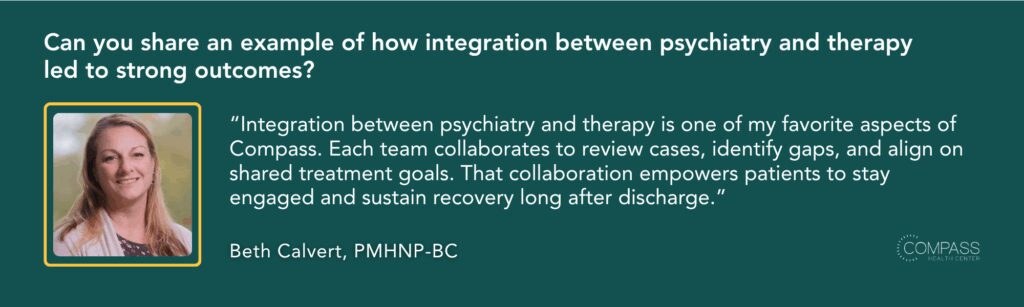
BT: Can you share an example of how integration between psychiatry and therapy led to strong outcomes?
BC:
Integration between psychiatry and therapy is one of my favorite aspects of Compass. Each team collaborates to review cases, identify gaps, and align on shared treatment goals. That collaboration empowers patients to stay engaged and sustain recovery long after discharge.
BT: How does Compass’s team approach help patients build long-term stability after discharge?
BC:
Our goal is always to maximize symptom reduction and improve daily functioning. Compass tracks patient progress closely—what we call being “in the zone”—which helps guide optimal treatment length. We also ensure smooth handoffs to outpatient providers and follow-up supports for continuity after discharge.
BT: How do you help patients and families navigate stigma, uncertainty, or fear around psychiatric medication?
BC:
Education! I’ve found that hesitation around medication usually comes from a lack of understanding. I use clear, simple language—avoiding overly clinical terms—to explain indications, benefits, and possible side effects. I meet patients and families where they are and help them feel informed, confident, and empowered in their choices.
BT: What do you find most rewarding about supporting patients through their recovery journey?
BC:
I love reflecting on a patient’s progress—how they’ve changed from their first day to their last. I often remind them of how they initially answered certain questions compared to how they answer now. Reviewing their assessment tools and showing them measurable progress reinforces that recovery isn’t linear—but it’s real and possible.
BT: What excites you most about Compass’s future in Wisconsin?
BC:
Being part of the first Compass clinic in Wisconsin is so exciting. I’m eager to see how we grow—just as Compass has expanded across Illinois. There are many areas in Wisconsin that lack mental health resources, and I’m proud that Compass is providing both in-person and virtual access across the state.
BT: How do you hope to see mental health care continue evolving in this community?
BC:
I’d love to see more community-based care and prevention—especially through primary care settings that connect patients to mental health resources early. Early intervention and individualized support can make a lasting difference.

Bios
Beth Calvert, MSN, PMHNP-BC, is a board-certified psychiatric mental health nurse practitioner with more than 23 years of experience across emergency, medical, and behavioral health settings. Before joining Compass, she spent over five years providing PHP and IOP psychiatric care for adolescents and adults, treating mood, anxiety, OCD, and trauma-related conditions. Beth brings a collaborative, patient-centered approach to medication management, working closely with multidisciplinary teams to deliver coordinated, evidence-based care. Inspired by her own family’s experience navigating the mental health system, she is committed to expanding access to timely, specialized treatment for patients and families across Wisconsin. She earned her MSN from Walden University, her BSN from Chamberlain College of Nursing, and her Associate Degree in Nursing from MATC.
Britt Teasdale is a writer, photographer, and creative strategist. As Associate Director of Brand and Content at Compass Health Center, she has spent nearly a decade shaping narratives that translate complex clinical ideas into stories that resonate, reduce stigma, and help families access care. She holds a degree in Broadcast and Investigative Journalism, MFA in Creative Nonfiction Writing, and began her career as a reporter. She is also co-host of Compass’s forthcoming podcast, You Only Know What You Know.