
Healing Together Through Collective Trauma: A Guide for Clinicians and Caregivers
When communities experience trauma—whether through mass violence, systemic injustice, political unrest, or public health crises—the impact extends far beyond the immediate event. It shows up quietly and persistently: in therapy rooms, classrooms, family dynamics, and daily routines. Symptoms intensify. Coping narrows. A shared sense of safety erodes.
Compass Health Center’s December 2025 Continuing Education presentation, Healing Together: Supporting Clients During and After Collective Trauma, explored how clinicians, caregivers, and communities can better understand and respond to these moments with nuance, compassion, curiosity, and evidence-based care.
Who this is for: Clinicians, parents, educators, and community providers supporting children, adolescents, young adults, adults, and families impacted by trauma, grief, and loss.
Understanding Collective Trauma—Not Just Individual Symptoms
Traditional definitions of trauma often focus on a single event experienced by an individual. Collective trauma expands that lens. It refers to traumatic experiences shared by groups or communities and shaped by historical, structural, political, and social forces.
Events such as mass shootings, racism, xenophobia, pandemics, natural disasters, or chronic community violence disrupt a collective sense of safety and belonging. Even those not directly harmed may experience heightened anxiety, grief, or dysregulation simply by living within an affected community.
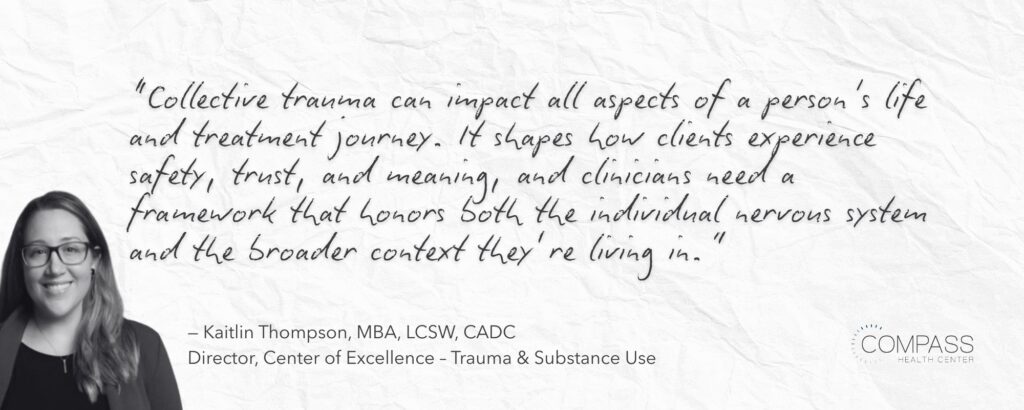
“Collective trauma can impact all aspects of a person’s life and treatment journey. It shapes how clients experience safety, trust, and meaning, and clinicians need a framework that honors both the individual nervous system and the broader context they’re living in.” — Kaitlin Thompson, MBA, LCSW, CADC, Director, Center of Excellence – Trauma & Substance Use
Recognizing collective trauma allows clinicians to contextualize symptoms rather than pathologize them and to respond with care that acknowledges both individual and shared experiences.
Loss and Grief After Trauma: What’s Normal, What Needs Support
When collective trauma occurs, loss takes many forms. Communities may grieve people, routines, predictability, trust, or a sense of normalcy. Grief, in this context, is not something to resolve quickly—it is a natural, adaptive response.
The presentation distinguished between typical grief, traumatic grief, and prolonged grief disorder, emphasizing that grief can be lifelong without being pathological. Clinically, the focus is not on eliminating grief, but on understanding its impact on functioning, relationships, and daily life.
This distinction helps clinicians support clients without rushing healing or framing pain as a problem to fix.
Why Psychoeducation Is a Critical Trauma Tool
One of the most practical interventions highlighted was psychoeducation—helping clients understand how trauma affects the brain and body.
Trauma responses such as hypervigilance, emotional numbness, difficulty concentrating, or strong startle responses are not failures of coping. They are protective nervous system responses shaped by survival mechanisms.
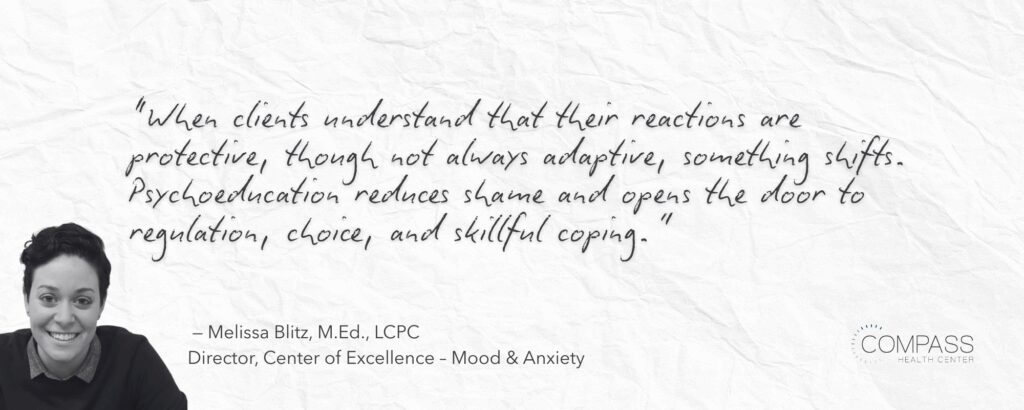
“When clients understand that their reactions are protective, though not always adaptive, something shifts. Psychoeducation reduces shame and opens the door to regulation, choice, and skillful coping.” — Melissa Blitz, M.Ed., LCPC, Director, Center of Excellence – Mood & Anxiety
By normalizing these responses, clinicians can reduce shame and help clients choose coping strategies that align with the moment, rather than attempting to “out-logic” a trauma response.
Evidence-Based Skills That Support Regulation and Coping
Rather than offering a one-size-fits-all approach, the presentation emphasized flexible, evidence-based strategies drawn from DBT, CBT, and ACT, including:
- Distress Tolerance skills such as temperature change, paced breathing, and grounding through the five senses
- Emotion Regulation strategies that prioritize sleep, nourishment, movement, and self-compassion
- Coping Ahead tools to plan for future stressors without reinforcing worry or rumination
- Acceptance and Validation practices that make space for emotions without amplifying distress
These skills are most effective when personalized, taking into account age, developmental stage, cultural context, and available supports.
Talking With Children After Collective Trauma
For parents and caregivers, conversations after traumatic events can feel daunting. The guidance offered emphasized co-regulation over explanation.
Children often need reassurance, presence, and emotional safety more than details. Following a child’s lead, validating emotions, and reinforcing safety can help prevent overwhelm while still honoring their experience.
These conversations are less about having perfect answers and more about being emotionally available.
Supporting the Helpers: Clinician Reflection and Care
Finally, the presentation acknowledged that the toll collective trauma can take on clinicians themselves. Supporting others through crisis can activate personal, interpersonal, and historical wounds.
Sustainable trauma-informed care requires self-reflection, boundaries, mindful media consumption, and connection with community. Knowing when to seek support—or when to refer out—is a strength, not a limitation.

Why Collective Trauma Awareness Matters Now
Collective trauma continues to shape how individuals experience safety, relationships, and mental health. By integrating trauma-informed, context-aware care, clinicians and caregivers can help reduce isolation, normalize responses, and support meaningful coping during uncertainty.
Addressing collective trauma is not about having all the answers. It’s about creating space—for understanding, for regulation, and for connection—when communities need it most.
Learn more about our Trauma & PTSD Treatment Programs and upcoming Continuing Education opportunities here.