When Young Adulthood Feels Stuck: Understanding the In-Between — and How to Find Your Way Forward
Young adulthood is often framed as a launch point: a clean break from home, a clear next step, momentum. Yet for many 18–25-year-olds, it doesn’t feel like taking off. It feels like a pause. The path that once seemed obvious can start to look blurry. Motivation drops. Confidence wobbles. Social circles shift or shrink. Days get later. Routines get thinner. And in the quiet gap between “what’s next” and “I don’t know,” anxiety and depression can start to take up more space.
In Compass Health Center’s Young Adult Program, we meet young adults and families right in that in-between: when life looks fine from the outside, yet internally, it feels harder to move. In the conversation below, Britt Teasdale speaks with Laura Hetue, LCSW, Director, Young Adult Program, Northbrook, about what she’s seeing now compared to pre-COVID, why so many young adults feel disconnected or stuck, and how structured, psychiatrist-led PHP and IOP programming can help rebuild momentum through community, skills practice, and small, realistic steps that add up over time.
Laura also breaks down one of the most deceptively powerful tools we teach across age groups: SEEDS (sleep, eating, exercise, doctor’s orders, and self-care), and why “getting unstuck” often starts with basics that feel almost too simple to matter—until they do.
Q&A
Britt: Could you tell me a little bit about yourself and your role within Compass, and how you landed in it?
Laura: I just had my seven-year anniversary at Compass. So I’ve been at Compass, Northbrook, in the Young Adult Program the whole time. I’m a social worker at heart—that’s my discipline. I started as a group therapist in the Young Adult Program, and then became the associate director doing more of the primary work, and now I’m the director.
I really love this population. I feel like I’ve seen changes Compass has made with the types of support, and also patient changes. The young adults coming to us in 2019 and the struggles they were having—some of those look the same, but a lot are different, especially post-COVID. There are so many more struggles young adults go through right now. It’s a different landscape from when I was a young adult.
What’s Changed for Young Adults in the Past Seven Years
Britt: That’s so interesting. Can you tell me what you were seeing in 2019 versus how things have changed for young adults—what kinds of things they’re dealing with now, and what has changed?
Laura: I think in 2019 I was still seeing more of the traditional track. Most of our young adults were looking to go to school and were getting support with that being the path they were on.
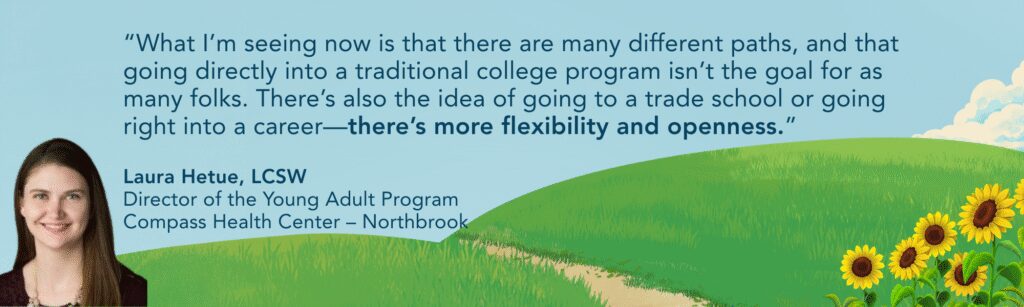
What I’m seeing now is that there are many different paths, and that going directly into a traditional college program isn’t the goal for as many folks. There’s also the idea of going to a trade school or going right into a career—there’s more flexibility and openness.
I also think the social connection—and the lack thereof—when COVID hit for our young adults, because that would have been around high school-ish, give or take. There’s increased loneliness, more difficulty connecting. The pressures of social media over the last seven years have only gotten more intense.
So I see that disconnection showing up more in uncertainty around how to connect, find friends, or relate to other people their age—especially in person.
And even knowing that since I started, we have virtual treatment—people are doing therapy virtually—the world has opened up where you don’t necessarily have to leave your house to get support. That was a big shift. More young adults did home learning, whether that was during COVID or even afterwards compared to before.
So that idea of “How do I get out into the world? How do I find my space? Where can I find my people?” seems so much harder.
How Loneliness and Disconnection Impact Mental Health
Britt: And those areas of disconnect or feelings of loneliness impact mental health, and that’s why they’re coming to Compass. Can you talk about how those feelings and experiences are impacting mental health?
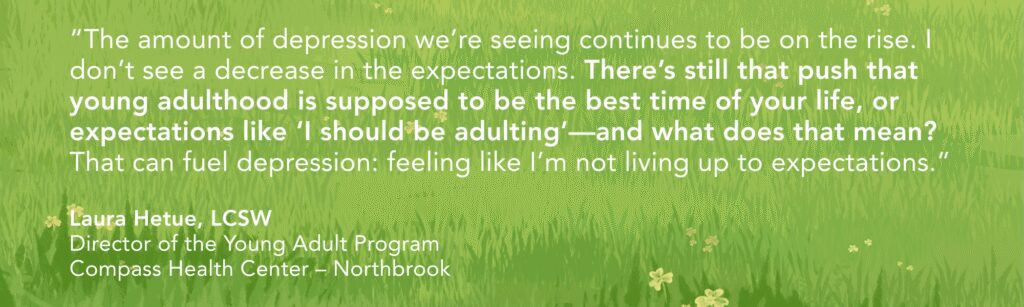
Laura: The amount of depression we’re seeing continues to be on the rise. I don’t see a decrease in the expectations. There’s still that push that young adulthood is supposed to be the best time of your life, or expectations like “I should be adulting”—and what does that mean? That can fuel depression: feeling like I’m not living up to expectations.
There’s a high level of anxiety too, going from having a more clear path in high school or more parental involvement to having a lot more options and roads, being the decision-maker, and how daunting that can feel.
So depression, lack of support—and knowing that a lot of support systems that were in place, whether systematic like high school clubs, activities, friends—people go off and do their own thing. If folks had the luxury of stable support before young adulthood, it isn’t necessarily there in the same ways now.
And that comparison with peers—“Am I where other people are? Am I where I’m expected to be?”—it’s an incredibly tough age.
What Helps Young Adults Cope and Move Forward
Britt: How do we help young adults work through those feelings? I feel like those feelings have always been there to an extent—“okay, what now?”—the world feels really big. How do we work through those feelings with young adults? How do we help them cope?
Laura: I think naming it right off the bat is such an important piece. I love individual therapy, but something Compass does so well and is a core part of our work is the group component. Bringing people together in a similar stage of life to say, “You’re not alone in this.”
Our Young Adult Program, compared to other PHPs, is a narrower window—18 and out of high school up to 23, 24, sometimes 25. It targets what their experience is, and they can see there’s a whole program of peers having similar experiences.
I also think the structure of Compass—if you’re able to come in person, there’s something so beneficial about that. Not everyone can, and that’s why we have virtual. But interacting on site, on breaks, learning or fine-tuning soft skills—that’s important.
One piece I notice looking different pre-COVID to now is soft people skills were maybe a little sharper. Now they’re more out of practice, or they weren’t as needed if a lot was happening virtually or through the computer. You don’t have to sit in a classroom until the professor comes. You don’t necessarily have to interact.
So developing that and gaining confidence for folks who assume they can’t do this because they haven’t, or it’s gone badly in the past—to say, “Wait, I’m proving to myself I can do hard things,” like coming to program, interacting, using distress tolerance skills. That confidence can really improve mental health outcomes.
Feeling “Set Up” After High School
Britt: How are you finding that—do young adults feel set up during high school years to move on to the next stage, or most do not?
Laura: That’s a great question. I think we see both extremes. Sometimes folks feel like they were set up, but the reality versus expectations can be different.
There are folks who leave high school and they’re like, “Now what?” They try some stuff out and sometimes find their way. There are other people who did have a clear path, and they try it and go, “This isn’t what I thought it would be,” or “This isn’t feeling the way I hoped it would feel.”
We see a lot of people—especially at Northbrook—coming home to live with parents. Maybe they’d been away at school, or they’ve been at home deciding what the next step is and needing support, because it’s incredibly daunting: “You’re 18, pick your future.” It can feel that way even with nuances—that it doesn’t have to be so all-or-nothing.
Living at Home: Embarrassment, Comfort, and the Push-Pull
Britt: For young adults living at home—whether they never went off to school or they’re coming back—do you see embarrassment, comfort, both?
Laura: It depends on who you talk to. A lot of the work I do here, and the team does, is managing the idea of feeling like a burden. That resonates with a lot of our folks: “I’m reliant on other people. I feel like a burden. I’m embarrassed compared to my peers. I’m judging myself harshly.” There’s a lot of negative self-talk.
On the flip side, there can be comfort, and it can be easy to get stuck in that cycle. If needs are being met or things are the status quo, change and uncertainty can be overwhelming. It’s like, “I know I’m not happy now, but I know what this looks like,” versus taking the next step where there’s no guarantee I’m going to like it—and it’s really scary.
It can be both. That dialectic—feeling comfortable and feeling like a burden—makes it more complex.
Social Media and Comparison
Britt: Social media plays into this—feeling comfort at home, yet seeing peers out doing things and comparing.
Laura: Yeah, absolutely. Social media—seeing how people are connecting with friends—it’s a lot. For a lot of folks, there are no in-person social connections. It’s “we hop on a video game and that’s how we’re interacting.” So there’s the disconnect of seeing what other folks might be doing or posting versus the isolation many young adults experience.
Is This Happening in High School Too?
Britt: Is that isolation—interacting with friends solely online—happening in high school too, or is it a big shift post-high school?
Laura: It really depends. Now there’s the option of doing high school virtually, and I’m assuming that’s happening more often than pre-COVID. For those folks, things are circling online. That’s the main source of connection, sometimes therapy and other support. So it can be healthy and hopeful.
But then there’s the piece of: how do we interact with people in person?
For folks who were going to high school in person, there’s natural interaction and structure Monday through Friday, which automatically falls off if there’s not new structure after graduation—school, work.
The less you do something and the more time away from it, the scarier it is. I talk about how the first day of school and the hundredth day of school look really different. That’s how I imagine a lot of our young adults feel coming to Compass: “I haven’t interacted or been expected to show up like this for a long time.” It can be a hard first step to show up on site.
When Someone Feels Stuck: How Treatment Helps
Britt: If someone feels stuck and like they’re not making progress with their life and mental health, how are we supporting them—within group, individual therapy, and the psychiatry component?
Laura: Highlighting strengths—sometimes having someone else do it—especially when there’s a lot of negative self-talk or self-judgment. They might not be seeing the progress. Even doing intake or starting programming is huge progress.
What’s really lovely is how Compass works with wraparound services. We have the group space and group therapists patients interact with daily—honing in on: What are the barriers? What are the struggles? What do we do about this? What’s in our control? The skills are incredibly helpful. They’re people skills. They’re more essential when you’re struggling, but they’re life skills too.
Then there’s individual space with the primary therapist to delve into more detail. Medication can be a piece of the puzzle and it’s fully incorporated. Nothing is working in a silo. It’s all navigated together, which is different than outpatient care.
We’re seeing you as a whole person in different settings—in group, one-on-one. Family therapy is another big one for young adult age. Having family involvement, whoever they’re living with, to ask: How can the people around you support you when you’re making efforts to get unstuck?
It can be a whole-family process. Let’s get everyone unstuck. What’s contributing to the stuckness? What are realistic, small, concrete changes that are attainable?
When someone is struggling, the full picture can be daunting and scary, and the question is: where do I start? What Compass and our team does is break that down—here are some places to start. Let’s try this and we’ll see you tomorrow. If it was harder than imagined, we’ll talk about it. If it went really well, we’ll talk about it, build up that success, and give you credit.
Family Expectations and Pressure to “Have a Plan”
Britt: Are you seeing unrealistic pressure to have a plan being placed on young adults from families or loved ones? How does education around that happen?
Laura: I think it absolutely does. Expectations are fascinating. Families often have high expectations. Sometimes young adults assume families have certain expectations or it’s been internalized: “This is what I’m expected to do.”
What’s really lovely in family therapy is providing education for everyone and space to get everything on the table.
It’s fascinating when a young adult says, “There’s no way my parents will be okay with me taking time off from college or taking a different path,” and sometimes those conversations are so supportive and positive. Not at all how the young adult imagined.
If it is a harder discussion, we focus on being realistic—what’s reasonable? Can we put ourselves in our young adult’s shoes?
This also applies to mental health in general. Sadness isn’t necessarily an emotion to be “fixed.” A lot of skills can sound like they’re to get rid of emotions. We’re humans—we’re going to have them. It’s how to be skillful, how to not have them take away from our goals and aspirations.
Sometimes it’s reformatting and identifying what support looks like. Most parents want the best. We don’t know what we don’t know. Sometimes we go about it in a way that worked for one child—but every kid is different and needs different things.
Having a designated space to talk about it, express it, be nonjudgmental—it can be a game changer. I’ve seen a lot of families get unstuck and discharge in a significantly better place, with a realistic plan and steps for staying on the same page.
When Family Therapy Feels Intimidating
Britt: What would you say to families or young adults who are hesitant about family therapy?
Laura: It happens a lot in the young adult world. When you’re 18, you have that ownership and you get to make the choice about parental involvement—it tends to be parents, but it can be anyone. It can be hard to let people in.
The way we talk about it is: if someone is working on themselves so much, it’s important to have a cheerleader or support member coaching you on. Whoever is the identified person coming to Compass, they really get to be the owner of who participates in family sessions—parent, both parents, roommate, significant other—whoever makes sense.
Family therapy can sound intimidating—everyone in a room, all the siblings. We demystify it. It doesn’t have to look that way. It’s structured. We’re not bringing up everything from the past. We’re focused on the here and now because this is about stabilization.
Young adults do a great job working with family therapists to set an agenda. It’s a space where families can express concerns and hear how the other person is perceiving it. In regular conversations we’re not always pausing to say, “Hey, that made me feel judged.” Family therapists slow things down so there’s space to realize how we’re coming across and how we’re being interpreted on both sides.
Small Shifts That Make a Big Difference: SEEDS and Behavioral Activation
Britt: Can you share a moment where a small shift made a big difference—something attainable for someone reading this?
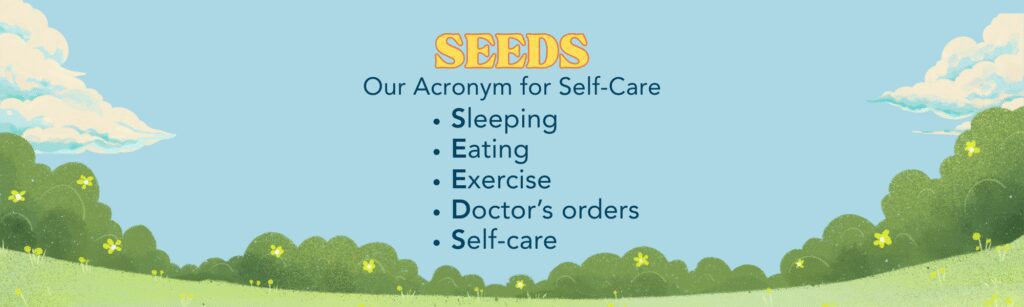
Laura: I’ve had a patient get unstuck by focusing on SEEDS, which is our acronym for self-care: sleeping, eating, exercise, following doctor’s orders—like taking medication as prescribed—and that last S is more generalized self-care.
It can feel basic. But the impact on mental health and daily functioning is tremendous. Focusing on sleep hygiene and getting good sleep. Prioritizing three meals a day. Some of these things happening simultaneously can be helpful.
If I’m nourishing my body the way it needs, emotion regulation often follows, and it’s easier to use other skills we teach. People are sometimes surprised by how much of an impact it has.
We also talk about behavioral activation—doing things that move your body. People think they need a full workout for it to matter. But walking from one side of the room to the other can mix things up. That change of scenery—getting up and moving locations—can be so helpful.
And coming to program (unless you’re virtual), coming on site, it’s built into the model: you’ve got to move. That can naturally be the start of game changers.
Virtual Life and the “Bedroom Hub”
Britt: Have you noticed with the increase in virtual learning and virtual interaction that this needs to be more thought through now?
Laura: I think so. We’re so reliant on technology, which is great, but moving and interacting doesn’t happen as much. For a lot of young adults, when they’re not in program, they’re spending time in their bedroom. They may be very productive, but there’s not much physical movement, not a lot of in-person interactions.
So being mindful and intentional, and going out of your comfort zone—if you can do everything in your room, it’s easy for that to become the hub.
The Science Behind Movement
Britt: Can you speak to the science behind moving—even changing locations?
Laura: Behavioral activation is one of the skills that has some of the most science behind it. I’m not a neuroscientist, but the idea of neuroreceptors being released when we physically move—there’s science to back up that it’s good for our bodies and really good for our brains.
Physical movement releases endorphins and other neuroreceptors that can be natural mood boosters. And as humans, we often feel more accomplished through change of scenery or pace. Moving from one room to another can help us feel physically unstuck—let me move where I’m at and let that be the start of the process.
How to Start SEEDS When You’re Overwhelmed
Britt: If someone feels overwhelmed by all the letters in SEEDS, how do you teach people to inch their way into it?
Laura: Breaking it down, because it can feel overwhelming. Skills can be individually adapted, which makes them accessible.
Sometimes it’s: what are we struggling with the most? Or what would be the most bang for our buck? If we’ve been prescribed medication and we keep forgetting it—set an alarm. “My first priority is to take the medication I’ve been prescribed,” because it was prescribed for a reason.
If sleep is off, ask: am I more irritable, more upset, easier to get frustrated because I’m not getting the sleep I need? It doesn’t have to be going from staying up until three or four to “9:30 bedtime.” It can be slowly pushing it back, or adjusting naps if that impacts sleep.
For others, it’s: I’m not eating, I’m not fueling my body—how can we slowly incorporate that?
It doesn’t have to be zero to 100. SEEDS is a maintenance skill—like doing resets—and we’re not going to do it perfectly. If something falls off, pay attention: what got in the way? Can we navigate barriers differently, or recommit?
It becomes easier when people see the benefit: “I feel a lot better when I’m sleeping well,” or “When I eat lunch every day, I’m doing better.” Interactions with friends and family are smoother because I’m not as irritable. Seeing that benefit can make it feel worth the effort.
Why SEEDS Goes Off Track in Young Adulthood
Britt: Why is it that during those 18–25 years, SEEDS can get so off track?
Laura: There’s a lot of newfound freedom. You have more ownership of your schedule. Parents taking a step back makes sense—parents aren’t waking you up at 18 or 19 the way they might at 5 or 6.
Peers are often on a similar schedule too. If you want to connect and everyone is up in the middle of the night, it’s hard to say, “No, I’m going to bed early.” It can feel like a give and take.
It’s also exploring as a new adult: what do habits look like when I’m in charge? What works? Sometimes you have to try things that are less effective before you realize, “Actually, this doesn’t work for me long-term.”
And young adults can be resilient. They can survive on four hours of sleep—up to a point. The consequences might not show up right away. But over time it can impact long-term. It’s not always easy to pinpoint unless you have the data point: “When I get eight hours of sleep, I’m a brand new person.”
Supporting Parents: Independence Without Over-Functioning
Britt: What would you say to parents who aren’t sure how much to let off the gas—how to support independence while still supporting their young adult?
Laura: Self-compassion, right off the bat. It can be hard to parent a child at this age in the landscape we live in, and it’s not one size fits all. There will be trial and error.
As a parent, naming some of that—being willing to be vulnerable and honest—can be helpful. They learn too: we’re not going to get it perfect the first time.
A model we talk about with parents is: if they can do it themselves, don’t do it for them. Not over-functioning. Giving opportunities—yes, it might be easier to do the laundry, but if they’re capable, it builds confidence. Those chores and tools can help with bigger steps.
And start small. If you’re doing a lot right now, going from zero to 100 is less effective. Scale it down: “Here’s the plan. I’m not going to wake you up anymore.” Or “I’ll remind you one time to take your medication, and then you’re responsible.” Try things out.
Family therapy helps because you have support to decide when to scale it up and create more space for independence.
Also: how comfortable are we making it at home? If your young adult is feeling stuck and they’re very comfy—things done for them, provided for, phone, internet—think: am I getting in the way of natural consequences? If they were on their own and not working, they wouldn’t be able to afford the phone. Is me paying for this getting in their way, or not creating a situation where they feel ready to move and get uncomfortable?
One Gentle Step to Consider Right Now
Britt: If a young adult is feeling stuck—or a parent feels their young adult is stuck—what’s one gentle step they could consider right now?
Laura: There are many different directions, and it’s not one size fits all. Self-compassion can come into play—how can I be a little bit kinder to myself, both on the parent side and the young adult side?
What’s nice too is knowing additional supports exist, and there’s no commitment to follow it through if it doesn’t feel like the right fit. Sometimes I’ll recommend scheduling the intake at Compass or trying a day—see how it feels. If at any point it’s like, “This isn’t for me,” that will be part of the discussion. We want it to feel like a good fit for everyone in program.
Especially if it feels like, “I don’t know how to take the first step on my own and I need support to get unstuck,” because that support system is so essential.
If you or your young adult is feeling stuck, Compass Health Center offers specialized, psychiatrist-led Partial Hospitalization (PHP) and Intensive Outpatient (IOP) programs for young adults ages 18–23+, available in person and virtually.
Bios
Laura Hetue, LCSW, Director, Young Adult Program, Northbrook, is a licensed clinical social worker who provides compassionate, client-centered mental health care. She has experience working in various levels of treatment including PHP and IOP, residential, outpatient, and community mental health settings. Laura has worked at Compass Health Center for since 2019, specializing in supporting young adults. She is committed to creating a collaborative and supportive therapeutic environment and utilizes evidence-based approaches—including Cognitive Behavioral Therapy (CBT), Dialectical Behavior Therapy (DBT), and Acceptance and Commitment Therapy (ACT)—to tailor treatment to each client’s unique needs, with a focus on building resilience, insight, and lasting change. She earned her Master of Social Work degree from Loyola University Chicago.
Britt Teasdale is a writer, photographer, and creative strategist. As Associate Director of Brand and Content at Compass Health Center, she has spent nearly a decade shaping narratives that translate complex clinical ideas into stories that resonate, reduce stigma, and help families access care. She holds a degree in Broadcast and Investigative Journalism, an MFA in Creative Nonfiction Writing, and began her career as a reporter. She is also co-host of Compass’s podcast, You Only Know What You Know